ENTRY AND START SYSTEM(for Start Function), Diagnostic DTC:B2282 and B2283
| DTC Code | DTC Name |
|---|---|
| B2282 | Vehicle Speed Signal Malfunction |
| B2283 | Vehicle Speed Sensor Malfunction |
DESCRIPTION
DTC B2282 is stored when a mismatch between the vehicle speed signal from the direct line sent by the combination meter and the vehicle speed signal sent via CAN communication is detected.
DTC B2283 is stored when a malfunction in the vehicle speed sensor is detected.
When the power management control ECU is replaced with a new one and the cable is connected to the negative (-) battery terminal, the power source mode changes to on (IG).
When the battery cable is disconnected and reconnected, the power source returns to the mode it was in before the battery cable was disconnected.
DTC No. |
Detection Item |
DTC Detection Condition |
Trouble Area |
|---|---|---|---|
B2282 |
Vehicle Speed Signal Malfunction |
Mismatch between the vehicle speed signal from the direct line sent by the combination meter and the vehicle speed signal sent via CAN communication (1-trip detection logic*). |
|
B2283 |
Vehicle Speed Sensor Malfunction |
Either condition is met (vehicle speed sensor malfunction is detected) (1-trip detection logic*):
|
|
*: Only output while a malfunction is present and the engine switch is on (IG)
DTC No. |
DTC Output Confirmation Operation |
|---|---|
B2282 |
Drive the vehicle for 20 seconds at a vehicle speed of 25 km/h (16 mph) or more, and then drive the vehicle at a vehicle speed that is less than 5 km/h (3 mph) for 20 seconds. |
B2283 |
DTC Code |
Vehicle Condition when Malfunction Detected |
Fail-safe Function when Malfunction Detected |
|---|---|---|
B2282 |
|
- |
B2283 |
|
Steering lock motor operation is prohibited. |
WIRING DIAGRAM
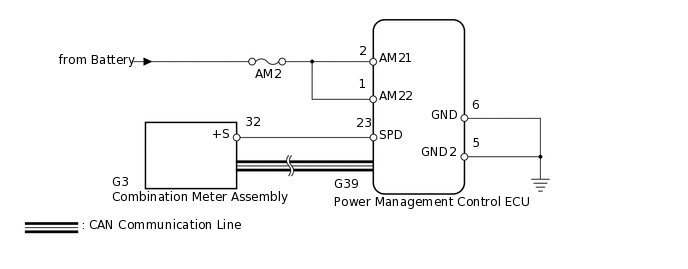
CAUTION / NOTICE / HINT
When using the intelligent tester with the engine switch off, perform either of the following: 1) Turn a courtesy light switch on and off at intervals of 1.5 seconds or less until communication between the intelligent tester and vehicle begins, or 2) connect the intelligent tester to the vehicle and select "MANUAL" from the initial screen on the intelligent tester, and then select "KEY REGIST" under Model Code.
The entry and start system uses multiplex communication. First perform the inspections in "How to Proceed with Troubleshooting" to confirm that there are no communication malfunctions before proceeding with troubleshooting (Click here).
Inspect the fuses of circuits related to this system before performing the following inspection procedure.
After performing repairs, perform the operation that fulfills the DTC output confirmation operation, and then confirm that no DTCs are output again.
DTC |
Data List Item |
Active Test Item |
|---|---|---|
B2282 B2283 |
|
- |
PROCEDURE
READ VALUE USING INTELLIGENT TESTER (VEHICLE SPEED METER)
Connect the intelligent tester to the DLC3.
Turn the engine switch on (IG).
Turn the intelligent tester on.
Enter the following menus: Body / Combination Meter / Data List.
According to the display on the intelligent tester, compare the actual vehicle speed with the Data List value.
Body Electrical > Combination Meter > Data List
Tester Display
Measurement Item
Range
Normal Condition
Diagnostic Note
Vehicle Speed Meter
Vehicle speed
Min.: 0 km/h (0 mph), Max.: 255 km/h (158 mph)
Almost same as actual vehicle speed (Speedometer tester)
-
OK
The Data List value is approximately the same as the actual vehicle speed.
Result
Result
OK
NG
READ VALUE USING INTELLIGENT TESTER (VEHICLE SPEED SIGNAL)
Connect the intelligent tester to the DLC3.
Turn the engine switch on (IG).
Turn the intelligent tester on.
Enter the following menus: Body / Power Source Control / Data List.
According to the display on the intelligent tester, read the Data List.
Body Electrical > Power Source Control > Data List
Tester Display
Measurement Item
Range
Normal Condition
Diagnostic Note
Vehicle Speed Signal
Vehicle moving or stationary
Stop or Run
Run: Vehicle moving at 5 km/h (3 mph) or more
Stop: Vehicle stopped
-
OK
Stop (vehicle stopped) or Run (vehicle driven) appears on the screen according to the vehicle speed.
Result
Result
OK
NG
CHECK HARNESS AND CONNECTOR (BATTERY - POWER MANAGEMENT CONTROL ECU)
Disconnect the G39 power management control ECU connector.
-
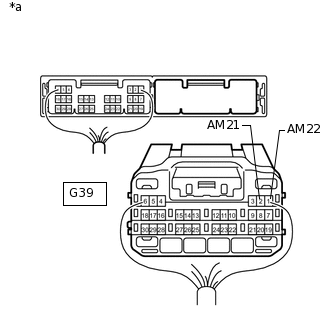
*a
Rear view of wire harness connector
(to Power Management Control ECU)
Measure the voltage according to the value(s) in the table below.
Standard Voltage
Tester Connection
Condition
Specified Condition
G39-2 (AM21) - Body ground
Always
9.5 to 14 V
G39-1 (AM22) - Body ground
Result
Result
OK
NG
NG REPAIR OR REPLACE HARNESS OR CONNECTOR IN CIRCUIT CONNECTED TO POWER SOURCE
CHECK HARNESS AND CONNECTOR (POWER MANAGEMENT CONTROL ECU - BODY GROUND)
-
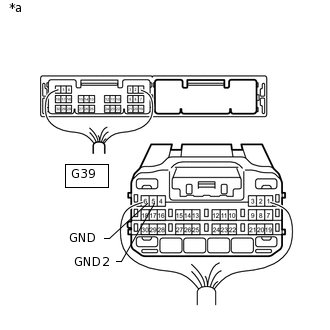
*a
Rear view of wire harness connector
(to Power Management Control ECU)
Disconnect the G39 power management control ECU connector.
Measure the resistance according to the value(s) in the table below.
Standard Resistance
Tester Connection
Condition
Specified Condition
G39-6 (GND) - Body ground
Always
Below 1 Ω
G39-5 (GND2) - Body ground
Result
Result
OK
NG
NG REPAIR OR REPLACE HARNESS OR CONNECTOR
-
CHECK HARNESS AND CONNECTOR (POWER MANAGEMENT CONTROL ECU - COMBINATION METER)
Disconnect the G39 power management control ECU connector.
Disconnect the G3 combination meter assembly connector.
Measure the resistance according to the value(s) in the table below.
Standard Resistance
Tester Connection
Condition
Specified Condition
G39-23 (SPD) - G3-32 (+S)
Always
Below 1 Ω
G39-23 (SPD) or G3-32 (+S) - Body ground
Always
10 kΩ or higher
Result
Result
OK
NG
NG REPAIR OR REPLACE HARNESS OR CONNECTOR
CHECK COMBINATION METER ASSEMBLY
Using an oscilloscope, check the vehicle speed input signal waveform from the combination meter at the terminal of the power management control ECU.
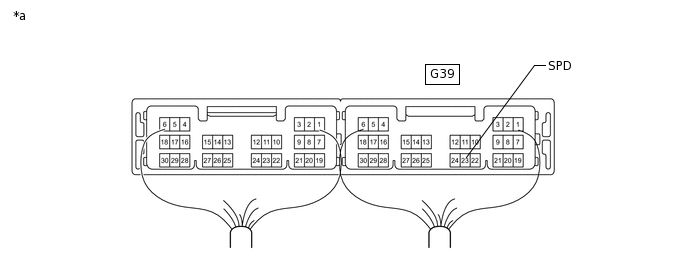
*a
Component with harness connected
(Power Management Control ECU)
-
-
-
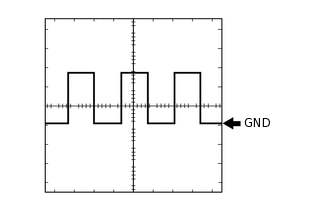
Check the signal waveform according to the condition(s) in the table below.
Standard Frequency
Tester Connection
Tool Setting
Condition
Specified Condition
G39-23 (SPD) - Body ground
5 V/DIV., 100 ms./DIV.
Engine switch on (IG), vehicle being driven at approx. 5 km/h (3 mph)
Correct waveform is as shown in illustration
Result
Result
OK
NG
-