THEFT DETERRENT SYSTEM SYSTEM DESCRIPTION
THEFT DETERRENT SYSTEM DESCRIPTION
*1: w/ Security Horn Assembly
*2: w/ Theft Warning Siren Assembly
The theft deterrent system is designed to deter vehicle break-ins and theft. If an attempted break-in or theft is detected, the vehicle horns and security horn*1 or theft warning siren*2 sound and hazard warning lights flash. The system detects an attempted break-in or theft when any of the following occurs: 1) the vehicle is forcibly entered; 2) the engine hood is forcibly opened; 3) the doors are unlocked without the use of a key; or 4) the cable is disconnected from the negative (-) battery terminal and then reconnected.
If the system enters the alarm sounding state, any unlocked doors automatically lock.
The system has an active arming mode (refer to Active Arming Mode).
Active arming mode has 4 states: disarmed state, arming preparation state, armed state and alarm sounding state.
Disarmed state:
The alarm function is not operating.
The theft deterrent system is not operating.
Arming preparation state:
The theft deterrent system is not operating.
Armed state:
The theft deterrent system is operating.
Alarm sounding state:
The alarm function is operating (Approximately 27.5 seconds).
Table 1. Alarm Method and Time Alarm Method
Hazard Warning Lights
Blinking (cycle of flasher relay)
Vehicle Horns
Sounding (cycle of 0.4 seconds)
Security Horn *1
Sounding (cycle of 0.4 seconds)
Theft Warning Siren *2
Sounding (cycle of 0.4 seconds)
Security Indicator Light
Illuminating
Alarm Time
Approximately 27.5 seconds
Tip:If, during the alarm sounding state, one of the doors is unlocked without using a proper key, a forced door lock signal is output (refer to Forced Door Lock Control).
FUNCTION OF MAIN COMPONENT
Function
Outline
Security indicator light
Informs the driver of the theft deterrent system status.
Hazard warning lights
Begin flashing when an attempted break-in or theft is detected.
Low pitched horn
Sounds when an attempted break-in or theft is detected.
High pitched horn
Sounds when an attempted break-in or theft is detected.
Security horn*1
Sounds when an attempted break-in or theft is detected.
Theft Warning Siren*2
Sounds when an attempted break-in or theft is detected.
Door courtesy light switches
Detect the door status (open or closed).
Back window lock
Detects the glass hatch status (open or closed).
Door lock position switches
Detect the door lock status (locked or unlocked).
Security courtesy switch
Detects the engine hood status (open or closed).
Power management control ECU
Detects the engine switch condition [off, on (ACC) or on (IG)].
*1: w/ Security Horn Assembly
*2: w/ Theft Warning Siren Assembly
ACTIVE ARMING MODE
Tip:Active arming mode starts alarm control immediately after the doors are locked.
System State
State Switching Condition
Transfer to
1. Disarmed state
Perform one of following with engine switch off and system changes to "arming preparation state":
With all doors, engine hood and glass hatch closed, lock all doors by entry lock operation or wireless operation
With engine hood open, lock all doors and close engine hood
With glass hatch open, lock all doors and close glass hatch
2. Arming preparation state
2. Arming preparation state
Perform one of following and system changes to "disarmed state":
Unlock all doors by entry unlock operation or wireless operation
Unlock door
Open door
Open engine hood
Open glass hatch
Turn engine switch on (IG) or on (ACC)
Reconnect battery
1. Disarmed state
Perform one of following and system changes to "armed state":
Approximately 30 (+/-1.5) seconds to elapse*1
Approximately 10 (+/-1.5) seconds to elapse*2
3. Armed state
3. Armed State
Perform one of following and system changes to "disarmed state":
Unlock all doors by entry unlock operation or wireless operation
Open glass hatch by entry glass hatch open operation or wireless operation
Turn engine switch on (IG) or on (ACC)
1. Disarmed state
Perform one of following and system changes to "alarm sounding state":
Open engine hood
Open glass hatch
Open door
Unlock all doors without entry unlock operation or wireless operation
Disconnect and reconnect cable to negative (-) battery terminal
Force engine ignition system to turn on without proper engine start method
4. Alarm sounding state
4. Alarm sounding state
Perform one of following and system changes to "disarmed state":
Unlock all doors by entry unlock operation or wireless operation
Open glass hatch by entry glass hatch open operation or wireless operation
Turn engine switch on (IG) or on (ACC)
1. Disarmed state
Perform one of following and system changes to "armed state":
Approximately 27.5 seconds to elapse
3. Armed state (alarm stops sounding)
*1: for Arming Preparation State 30 Seconds
*2: for Arming Preparation State 10 Seconds
FORCED DOOR LOCK CONTROL
Forced door lock control also helps to prevent the vehicle from being tampered with. When a door is unlocked and the alarm starts, the door is forced to lock by a forced door lock signal.
Conditions that force the doors to lock:
0.4 seconds have elapsed after the previous output of a forced door lock signal.
The theft deterrent system is in the alarm sounding state.
A door is unlocked.
PANIC ALARM CONTROL (w/ Panic Alarm Control)
Panic alarm control activates the panic alarm when the wireless transmitter panic switch is pressed. Panic alarm control operates independently from the change of theft deterrent system alarm control from the armed state to the alarm sounding state.
The panic alarm is activated when the panic switch on the wireless transmitter is pressed and held for 1.0 seconds or more under the following conditions.
The engine switch is off.
The theft deterrent system is not in the alarm sounding state.
Panic alarm control is not operating (the alarm is not sounding).
The panic alarm is deactivated when any of the following conditions is fulfilled during panic alarm operation.
The engine switch is turned on (IG).
The wireless transmitter lock/unlock switch is pressed.
Approximately 27.5 seconds have passed and the panic alarm has ended.
The theft deterrent system changes to the alarm sounding state. However, the alarm still sounds, because the theft deterrent system has changed to the alarm sounding state.
Conditions for canceling the panic alarm are the same as for alarm control.
THEFT WARNING SIREN (w/ Theft Warning Siren Assembly)
The theft warning siren has an internal battery. If power to the theft warning siren is interrupted or any of the communication lines are open, the theft warning siren detects it and sounds the alarm using the internal battery.
The theft warning siren has the following alarm controls: normal alarm control and open circuit alarm control. Under normal alarm control, the alarm sounds based on instructions from the main body ECU (multiplex network body ECU) whereas under open circuit alarm control, the theft warning siren judges current security conditions and sounds the alarm by itself.
Normal alarm control
The theft warning siren sounds when the theft deterrent system is in the alarm sounding state and does not sound when the system is not in the alarm sounding state.
Tip:If communication interruption between the theft warning siren and main body ECU (multiplex network body ECU) continues for 70 seconds or more while the theft deterrent system is in the alarm sounding state, the theft warning siren stops sounding.
-
Open circuit alarm control
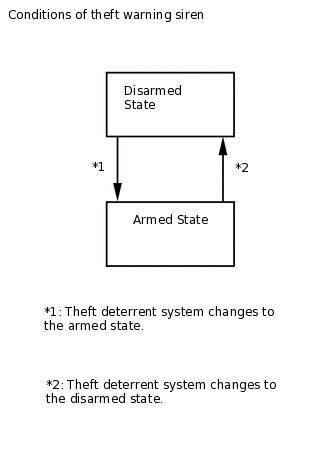
The theft warning siren changes between the disarmed state and armed state in accordance with the theft deterrent system change between the disarmed state and armed state. If +B, GND or the communication line is open while the theft warning siren is in the armed state, the theft warning siren sounds.
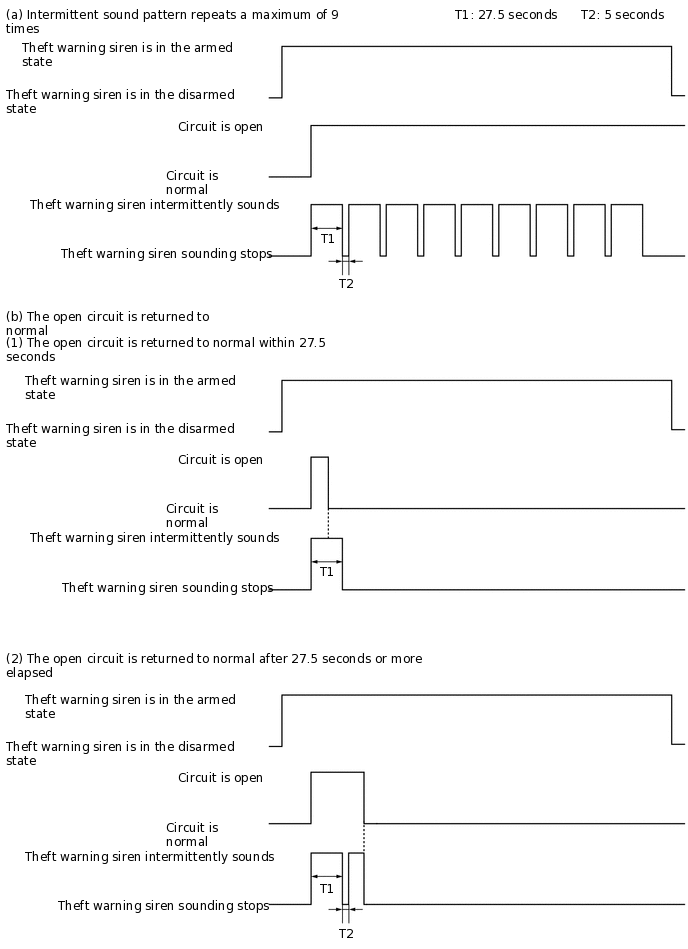
During the open circuit alarm sounding state, the theft warning siren sounds intermittently for 27.5 seconds and then stops for 5 seconds and this pattern repeats a maximum of 9 times.
The intermittent sound will stop when either condition is met:
The theft warning siren changes to the disarmed state.
The open circuit is returned to normal.
SECURITY INDICATOR LIGHT OUTPUT
The security indicator light turns on and off based on output signals from the main body ECU. However, in some cases, the actual status of the security indicator light is different from the output signals from the main body ECU.
Table 2. Output State of Theft Deterrent System
Security Indicator
Output Signals from ECU
Actual Lighting Condition
Disarmed state
Off
Off (Immobiliser system unset)
Blinking (Immobiliser system set)
Arming preparation state
On
On
Armed state
Off
Blinking
Alarm sounding state
On
On
Table 3. Blinking Cycle Time
Security Indicator
0.2 seconds
On
1.8 seconds
Off
Tip:When the engine immobiliser system is set, the security indicator light blinks during the disarmed state and armed state due to the output signals from the engine immobiliser system.