REFRIGERANT REPLACEMENT
-
RECOVER REFRIGERANT FROM REFRIGERATION SYSTEM
-
Start up the engine.
-
A/C switch is ON.
-
Operate the cooler compressor with an engine speed of approximately 1,000 rpm for 5 to 6 minutes to circulate the refrigerant and collect the compressor oil remaining in each component into the cooler compressor.
-
Stop the engine.
-
Using SST, Recover the refrigerant from the A/C system using a refrigerant recovery unit.
- SST
- 09985-20010 ( 09985-02130, 09985-02150, 09985-02090, 09985-02110, 09985-02010, 09985-02050, 09985-02060, 09985-02070 )
-
-
CHARGE REFRIGERANT
- SST
- 09985-20010 ( 09985-02130, 09985-02150, 09985-02090, 09985-02110, 09985-02010, 09985-02050, 09985-02060, 09985-02070 )
-
Perform vacuum purging using a vacuum pump.
-
Charge refrigerant HFC-134a (R134a).
Standard 450 +- 30 g (15.87 +- 1.05 oz.) 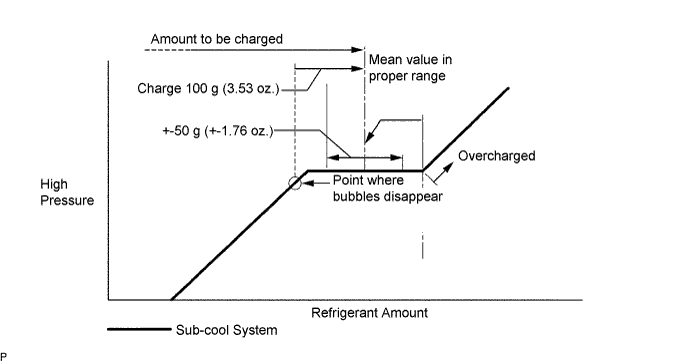
Note
-
Do not operate the cooler compressor before charging refrigerant as the cooler compressor will not work properly without any refrigerant, and will overheat.
-
Approximately 100 g (3.53 oz.) of refrigerant may need to be charged after bubbles disappear. The refrigerant amount should be checked by quantity, and not with the sight glass.
-
-
WARM UP ENGINE
-
Warm up the engine at less than 1,850 rpm for 2 minutes or more after charging refrigerant.
Note
After removing and installing the cooler refrigerant lines (with the compressor), be sure to warm up the compressor when turning the A/C switch ON. This is done to prevent damage to the compressor.
-
-
CHECK FOR LEAKAGE OF REFRIGERANT
-
After recharging the refrigerant gas, prepare the vehicle for a refrigerant gas leakage check by making sure the following conditions are met.
-
The ignition switch is OFF.
-
The vehicle is in a place with good air ventilation and without any volatile gases, such as evaporated gasoline or exhaust gas. The detector is very sensitive to volatile gases. If volatile gases are unavoidable, the vehicle must be lifted up.
-
Some refrigerant is remaining in the refrigerant system.
-
The compressor is OFF and its pressure is approximately 392 to 588 kPa (4 to 6 kgf/cm2).
-
-
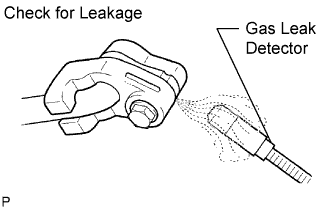
Check for refrigerant gas leakage from the refrigerant line.
-
After the blower motor stops, wait at least 15 minutes.
-
Using a gas leak detector, check that gas is not leaking from the refrigerant line. If leakage is found, tighten parts or replace damaged parts as necessary to stop the leak.
-
-
Check for refrigerant gas leakage from the cooling unit.
-
Hold the gas leak detector so that the sensor is under the drain hose, as shown in the illustration.
-
Check that gas is not leaking from the drain hose. If leakage is found, tighten parts or replace damaged parts as necessary to stop the leak.
-
-
Check for refrigerant gas leakage from the cooling unit.
-
Remove the blower motor control from the unit. Insert the gas leak detector's sensor into the unit.
-
Check that gas is not leaking from the unit. If leakage is found, tighten parts or replace damaged parts as necessary to stop the leak.
-
-
Check for refrigerant gas leakage from the pressure switch.
-
Disconnect the pressure switch connector and wait approximately 20 minutes.
-
Using a gas leak detector, check that gas is not leaking from the pressure switch. If leakage is found, tighten parts or replace damaged parts as necessary to stop the leak.
-
-
Repeat all steps above 2 to 3 times.
-