NAVIGATION SYSTEM / MULTI INFORMATION SYSTEM
-
FUNCTION OF MAIN COMPONENTS
Component Function Navigation Receiver Assembly*1 Receives and processes the data that is input from various components, displays various pieces of information and operating conditions on the screen, and provides voice guidance. Radio and Display Receiver Assembly*2
-
Extension Box (Navigation ECU)
Navigation Antenna Assembly*3 Receives signals from GPS satellites and transmits them to the navigation receiver assembly*1 or extension box (navigation ECU)*2. Combination Meter Assembly
-
Transmits vehicle speed signals to the stereo component amplifier assembly*4, navigation receiver assembly*1 or radio and display receiver assembly*2.
-
Displays information such as audio status information received from the audio head unit on the multi-information display.*5
-
Sends operation signals to the audio head unit when the audio system is operated via the multi-information display.*5
Steering Pad Switch Assembly Enables the user to operate the navigation system from the steering pad switches. Park/Neutral Position Switch Assembly*6 Transmits the R position signal to the navigation receiver assembly*1 or radio and display receiver assembly*2. Back-up Light Switch Assembly*7 Transmits the on/off signal of the back-up light switch assembly to the navigation receiver assembly*1 or radio and display receiver assembly*2. No. 1 Stereo Jack Adapter Assembly
-
Sends audio and/or video signals to the audio head unit when an auxiliary device is connected.
-
Communicates with the audio head unit via a USB communication line when a USB memory device, portable audio player (USB type) or Apple product is connected.
Telephone Microphone Assembly Recognizes speech during a hands-free call operation. Amplifier Antenna Assembly
-
AM
-
FM
-
GPS Antenna
-
Receives radio broadcasting signals (AM/FM).
-
Amplifies the received radio broadcasting signals using the built-in amplifier antenna assembly, and sends them to the audio head unit.
-
Receives signals from GPS satellites and transmits them to the audio head unit.*8
-
*1: Models with navigation receiver assembly
-
*2: Models with extension box (navigation ECU)
-
*3: Except Models for Russia
-
*4: Models with 11-speaker system
-
*5: Models with Optitron type combination meter assembly
-
*6: Models with automatic transaxle or CVT
-
*7: Models with manual transaxle
-
*8: Models for Russia
-
-
FUNCTION
-
Navigation Screen
-
The navigation computer calculates the present position and direction of travel, determines a route and calculates the driving distance based on the following information sources:
-
Map data in the microSD card (Models with navigation receiver assembly)
-
Map data in the extension box (navigation ECU) (Models with extension box (navigation ECU))
-
Global Positioning System (GPS) satellites
-
Built-in gyro sensor
-
Vehicle speed signal
-
Reverse signal
-
Parking brake signal
-
Radio Data System Traffic Message Channel (RDS-TMC) signal
Models with Navigation Receiver Assembly Item Function Map Display Taillight-interlocked Map Color Change Changes the color of the map screen when the taillights are turned on. North Up/Heading Up
-
If North Up is selected, north is always at the top of the map.
-
If Heading Up is selected, the direction the vehicle is traveling is at the top of the map.
3D Display Displays a 3-dimensional (3D) view of the map. Zoom In/Zoom Out Change the area of the map displayed on the screen. Tilt Up/Tilt Down In 3D mode, the user can change the vertical display angle of the map. Rotate Left/Rotate Right Rotates the map left and right. Street Name Indication on Scrolled Map Displays the street name and city name even when the map screen is being scrolled. Road Number Sign Board Displays the road number on the map. Point Of Interest (POI) Display Displays selected types of POI as marks on the map. Multiple Display Function Displays different modes on a screen that is split into 2 or 3 views. Route Guidance Demonstration Demonstrates route guidance to the destination. Route Trace Displays a list of all trip logs, whether they were saved by the user upon reaching the destination or whether they were saved automatically. RDS-TMC Display Displays RDS-TMC icons, arrows, pop-up messages and indicators when the RDS-TMC service is being received. Route Trace The user can search for the following services around the current position of the vehicle or the latest confirmed position:
-
Car Repair Around Here: Vehicle repairs/Road-side assistance services
-
Health Around Here: Hospitals/Emergency services
-
Police Around Here: Police stations
-
Petrol Station Around Here: Gas stations
Destination Search Preset Destination Memory Search A destination can be set from a pre-registered point while driving. Address Search Destination information can be entered in following order: area, town name, street name and house number. Hybrid POI Narrows the search by names of the POI, category and areas. Previous Destination Search Stores the coordinates, names, and date of up to 100 locations that have been set as destinations. Online Database Destination Search A destination can be set from a point searched for using the Toyota Link apps content. POI Search A destination can be set in 3 ways:
-
The name of a POI can be entered and searched for from city or category.
-
A POI category can be selected to search for a POI near the present location, along the current route, near the city center or near the destination.
-
A POI can be searched for by its phone number.
Map Search A destination can be set by scrolling the cursor on the map. Memory Point Search A destination can be set from the registered memory point. Intersection or Motorway Entrance/Exit Search A destination can be set in 2 ways:
-
By specifying 2 streets, the point at which they intersect is set as the destination point.
-
Searches for the destination by the name of the street that connects to a motorway entrance or exit.
Address Book (Memory Point) Search A destination can be set from the registered address book (memory point). Coordinate Search A destination can be input by entering its coordinates. Route Search Multiple Destination Setting Multiple destinatin can be set. The sequence of the destinations can be rearranged as well. Multiple Route Search Searches for multiple routes. Search Condition Designation Searches for quick, alternate and short routes. Destination Reordering Changes the order of destinations when more than one destination is selected. Detour Search Changes the route to detour around a section of the route. Avoidance Area Searches for a route that avoids a designated area. Auto Avoid Traffic Search Automatically changes to another route to avoid heavy congestion. Guidance Voice Guidance Provides voice guidance about the distance and the direction of travel to a destination point based on road conditions and vehicle speed. Next Turn Guidance Provides guidance about the distance to the next turn and indicates the direction of the turn using an arrow. Motorway Mode Display Displays the distance to the next junction and exit, or POIs in the area around a motorway exit. Motorway Exit or Junction Display When the vehicle approaches an exit or junction, the motorway guidance screen will be displayed. Motorway Direction of Travel Display Displays the direction of travel to take on the motorway. Real Motorway Junction Display Displays the junction and signage in 3D in the area around a major junction while driving. Intersection Zoom-in Display Zooms in the image when approaching an intersection. Turn List Display Displays a turn list on the right side of the 2-screen display. Arrow (Turn-by-turn) Display Displays the direction of the next turn and the distance to the turn on the right side of the 2-screen display. Lane List Display Displays a lane list on the right side of the 2-screen display. Distance-to-destination Display Displays the distance from the present location to the destination. Driver Support Information Icon Display Displays warning icons when the vehicle approaches areas such as school zones, railway crossings or high accident zones. Route Information Bar Display Displays the following information:
-
Street name of the current location
-
Distance and travel time to the destination
-
Distance to the destination and estimated time of arrival
-
Distance to the destination and an arrow facing the destination (when off the route during guidance)
Traffic Bar Display Displays traffic information of congestions or accidents on the route using the traffic bar. Others Voice Recognition Recognizes pre-programmed system commands spoken to operate the navigation system. Map Coverage Information Display Displays the map area that is stored on the microSD card. Models with Extension Box Item Function Map Display Taillight-interlocked Map Color Change Changes the color of the map screen when the taillights are turned on. North Up/Heading Up
-
If North Up is selected, north is always at the top of the map.
-
If Heading Up is selected, the direction the vehicle is traveling is at the top of the map.
3D Display Displays a 3-dimensional (3D) view of the map. Zoom In/Zoom Out Change the area of the map displayed on the screen. Street Name Indication on Scrolled Map Displays the street name and city name even when the map screen is being scrolled. Road Number Sign Board Displays the road number on the map. Point Of Interest (POI) Display Displays selected types of POI as marks on the map. RDS-TMC Display Displays RDS-TMC icons, arrows, pop-up messages and indicators when the RDS-TMC service is being received. Destination Search Preset Destination Memory Search Sets a pre-registered point as a destination point while driving. Address Search Destination information can be entered in the following order: area, town name, street name and house number. Previous Destination Search Stores the coordinates, names, and dates of up to 100 locations that have been set as destinations. Online Database Destination Search A destination can be set from a point searched for using the Toyota Link apps content. Point Of Interest Search A destination can be set in 4 ways:
-
By selecting a category and then a location.
-
By entering a name and then selecting a location.
-
By selecting a POI on the map.
-
By using the online search through connected services.
Map Search A destination can be set by scrolling the cursor on the map. Address Book (Memory Point) Search A destination can be set from the registered Address Book (Memory Point). Coordinate Search A destination can be input by entering its coordinates. Route Search Multiple Destination Setting Multiple destinations can be set. The sequence of the destinations can be rearranged as well. Search Condition Designation Searches for fast, short and ecological routes. Destination Reordering Changes the order of destinations when more than one destination is selected. Detour Search Changes the route to detour around a section of the route. Avoidance Area Searches for a route that avoids a designated area. Auto Avoid Traffic Search Automatically changes to another route to avoid heavy congestion. Guidance Voice Guidance Provides voice guidance about the distance and the direction of travel to a destination point based on road conditions and vehicle speed. Next Turn Guidance Provides guidance about the distance to the next turn and indicates the direction of the turn using an arrow. Motorway Exit or Junction Display When the vehicle approaches an exit or junction, the motorway guidance screen will be displayed. Distance-to-destination Display Displays the distance from the present location to the destination. Route Information Bar Display Displays the following information:
-
Street name of the current location
-
Distance and travel time to the destination
-
Distance to the destination and estimated time of arrival
-
Distance to the destination and an arrow facing the destination (when off the route during the guidance)
Traffic Bar Display Displays traffic information of congestions or accidents on the route using the traffic bar. Others Voice Recognition Recognizes pre-programmed system commands spoken to operate the navigation system. -
-
The fuel consumption screen is displayed as illustrated below. This screen has the display functions listed below:
Figure 1. Models with Navigation Receiver Assembly
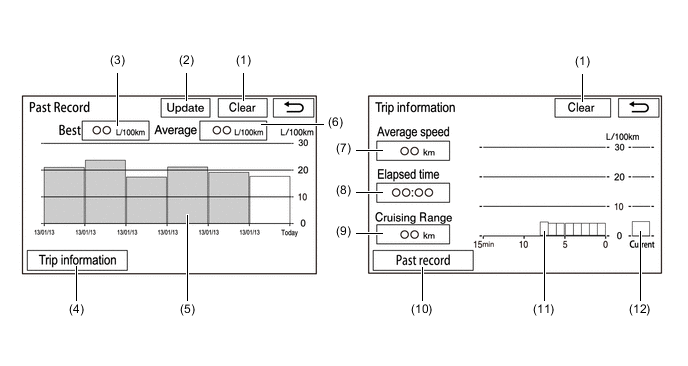
Item Outline (1) Clear Switch Clears all past information. (2) Update Switch
-
Restarts calculation of the average fuel consumption value.
-
Sends the average fuel consumption reset signal to the combination meter assembly to update the graph.
(3) Best Fuel Consumption Displays the best (most economical) fuel consmption per trip. (4) Trip Information Switch Changes to the average fuel consumption per minute screen. (5) Average Fuel Consumption per Trip
-
Displays the current record and the last 5 average fuel consumption per trip records or the current record and those since clear was last selected.
-
Starts calculating the average fuel consumption when the average fuel consumption displayed on the combination meter assembly is reset.
(6) Average Fuel Consumption Displays the average fuel consumption for the current trip and the previous 5 trips. (7) Average Speed Displays the value that has been calculated by the combination meter assembly, which is based on the distance driven and the time elapsed since the engine switch was turned on (IG). (8) Elapsed Time Displays the value that has been calculated by the combination meter assembly, which is based on the time elapsed since the engine switch was turned on (IG). (9) Cruising Range Displays the approximate drivable distance. (10) Past Record Switch Changes to the past record of the (per trip) fuel consumption screen. (11) Average Fuel Consumption per Minute
-
Displays the value that has been calculated by the combination meter assembly, which is based on the driven distance and the volume of fuel consumed (fuel injection signal), provided that the engine switch is on (IG).
-
Displays the average fuel consumption for the last 15 minutes or since clear was last selected.
(12) Current per Minute Fuel Consumption Displays the instantaneous (current) fuel consumption value that has been calculated by the combination meter assembly, which is based on the driven distance and the volume of fuel consumed (fuel injection signal), provided that the engine switch is on (IG). Figure 2. Models with Extension Box
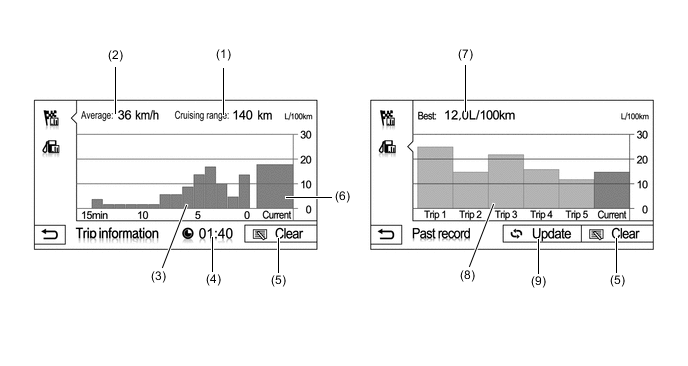
Item Outline (1) Cruising Range Displays the approximate drivable distance. (2) Average Speed Displays the value that has been calculated by the combination meter assembly, which is based on the distance driven and the time elapsed since the engine switch was turned to on (IG). (3) Average Fuel Consumption per Minute
-
Displays the value that has been calculated by the combination meter assembly, which is based on the driven distance and the volume of fuel consumed (fuel injection signal), provided that the engine switch is on (IG).
-
Displays the average fuel consumption for the last 15 minutes or since clear was last selected.
(4) Elapsed Time Displays the value that has been calculated by the combination meter assembly, which is based on the time elapsed since the engine switch was turned to on (IG). (5) Clear Switch Clears all of the past information. (6) Current Fuel Consumption per Minute Displays the instantaneous (current) fuel consumption value that has been calculated by the combination meter assembly, which is based on the driven distance and the volume of fuel consumed (fuel injection signal), provided that the engine switch is on (IG). (7) Best Fuel Consumption Displays the best (the most economical) fuel consumption per trip. (8) Average Fuel Consumption per Trip
-
Displays the current record and the last 5 average fuel consumption per trip records or the current record and those since clear was last selected.
-
Starts calculating the average fuel consumption when the average fuel consumption displayed on the combination meter assembly is reset.
(9) Update Switch
-
Restarts calculation of the average fuel consumption value.
-
Sends the average fuel consumption reset signal to the combination meter assembly to update the graph.
-
-
-
Setup Screen
-
The settings for the functions of the navigation receiver assembly are available from the setup screen.
Component Function General Settings
-
Time zones and automatic adjustment of the clock can be changed, and daylight saving time can be turned on/off.
-
The beep can be turned off.
-
The language can be selected.
-
The color of the screen buttons can be changed.
-
The keyboard layout can be changed.
-
The startup image can be changed.
-
The splash screen that displays when turning off the screen can be changed.
-
Automatic return to the home screen after completing operations on audio and other operation screens can be set.
-
Automatic return from the audio screen, etc. to the home screen after audio operation can be changed.
-
Registered information (personal data) can be cleared.
-
Navigation system software can be updated.
-
The Gracenote database can be updated.
-
Third party software information used in the navigation system, such as notices, can be displayed.
Voice Settings
-
The voice guidance volume can be adjusted.
-
Voice guidance during route guidance can be set.
-
Voice recognition prompts can be set.
-
The voice recognition function using the expanded voice commands can be set.
-
Desired guidance tone can be set.
Screen Settings The general screen and camera screen can be adjusted. Bluetooth Settings
-
Bluetooth devices can be registered.
-
Bluetooth devices can be deleted.
-
Bluetooth devices can be selected.
-
Bluetooth devices can be edited.
-
Bluetooth system settings can be changed:
-
Automatic connection to a Bluetooth device
-
Bluetooth device name
-
Bluetooth device PIN-code
-
Bluetooth device address
-
Display of Bluetooth device connection status
-
Bluetooth device profile
Phone Settings
-
A Bluetooth phone can be registered or connected.
-
Phone sound settings can be changed:
-
Call Volume
-
Ring Tone Volume
-
Ring Tone
-
Contact/Call history settings can be changed:
-
Change Contacts
-
Change Favorites
-
Delete Call History
-
Message function settings can be changed:
-
Message forwarding from cellular phones
-
New message notification display
-
New message voice notification
-
Adjust the new message notification volume
-
Select a new message voice notification tone
-
Automatic message readout
-
Adjust the message readout volume
-
Read and unread status update
-
Edit "Quick Reply Messages"
-
Phone display settings can be changed:
-
Change the incoming call display
-
Display of the automatic phonebook transfer completion message (for PBAP-compatible Bluetooth phone)
-
Display of the automatic call history transfer completion message (for PBAP-compatible Bluetooth phone)
-
Display of images during calls (for PBAP-compatible Bluetooth phone)
-
Orientation of images displayed during calls (for PBAP-compatible Bluetooth phone)
Audio Settings Settings can be changed for the following audio items:
-
Number of Radio Presets
-
iPod/USB Auto Play
-
Display Cover Art
-
Automatic Sound Levelizer
-
Cache Radio
Navigation Settings The navigation settings can be used to:
-
Set up home
-
Set up preset destinations
-
Set up the address book
-
Set up areas to avoid
-
Delete previous destinations
-
Set detailed navigation settings such as:
-
Average cruising speed
-
Automatic input function
-
Voice guidance for the next street name
-
Automatic reroute of the guidance route to avoid heavy congestion
-
Indication of freely flowing traffic by an arrow
-
Display of POI icon categories
-
Display of buttons on the map screen when "OFF" is selected
-
Manual adjustment of the current vehicle position mark
-
Display of pop-up messages
Toyota Link Settings
-
The voice guidance volume can be adjusted.
-
The phone data plan pop-up can be set when a paid application is downloaded.
Vehicle Settings
-
Settings can be changed for the following maintenance items:
-
Reminder
-
Engine oil
-
Oil filter
-
Rotation
-
Tires
-
Battery
-
Brake pad
-
Wipers
-
Coolant
-
Brake oil
-
Trans. fluid
-
Service
-
Air filter
-
Personal
-
Delete all
-
Reset all
-
Call dealer
-
Set dealer
-
Customizable vehicle settings can be changed.
Customize Home
-
The layout of the home screen can be changed between 2 and 3 panels.
-
Widgets can be selected for display.
Screen Off The screen can be turned off. -
-
The settings for the functions of the radio and display receiver assembly are available from the setup screen.
Component Function General Settings
-
Language: Select to change the language.
-
Volume settings: Select to set the volume for the phone/navigation.
-
Unit of measurement: Select to change the unit of measure for distance.
-
Beep: Select to set the beep sounds on/off.
-
Automatic text scrolling: Select to set the automatic text scrolling on/off. This function is not available while driving.
-
Backup stored contacts to USB: The entries stored in the "Stored" list on the "My destinations" screen and "Contacts" screen can be transferred to a USB memory.
-
Restore contact backup from USB: "vCard" formatted data can be transferred from a USB memory to this system. Transferred addresses and numbers will be stored in the "Stored" list on the "My destinations" screen and "Contacts" screen.
-
Delete all personal data: Select to delete all personal data stored in this system.
-
System information: Select to display the system information.
-
Open source information: Select to display the open source information.
Display Settings
-
Day mode: Select to set day mode on/off.
-
Screen off: Select to turn the screen off. To turn it on, press any button on the audio panel.
-
Contrast: Select to adjust the contrast of display.
-
Brightness: Select to adjust the brightness of display.
-
Camera: Select to adjust the camera display.
Audio Settings
-
Bass/Mid/Treble: Select to adjust the bass/mid/treble.
-
Balance/Fader: Select to adjust the balance/fader.
-
Automatic sound leveling: Select to set the Automatic sound leveling to low, mid, high or off.
-
Surround sound: Select to set the surround on/off.
Connectivity Settings
-
Bluetooth: Select to display a submenu for Bluetooth where you can connect phone, audio devices and internet devices via Bluetooth.
-
Wi-Fi: Select to display a submenu for Wi-Fi where you can connect internet devices via Wi-Fi.*
-
Connect me to Internet: Select to search for available internet connection methods.
-
Internet auto connection: Enable to automatically connect to internet.
-
Toyota web account: Select to add or change your Toyota web account.
Telephone Settings
-
Announce incoming messages: Select to set the incoming short message announcement function on/off.
-
Announce incoming emails: Select to set the incoming e-mail announcement function on/off.
-
Select ringtone: Select to set the desired ringtone.
-
Refresh phone book: Select to update the phone book of the connected phone manually. The updating takes place by referring to the phone book lists in the navigation/multimedia system phone.
Vehicle Settings Customizable vehicle settings can be changed.
-
*: Models with extension box (high grade type)
-
-
-
-
DIAGNOSIS
-
For details on the procedure required to enter the Service Menu screen, refer to the Repair Manual.
-