AUDIO AND VISUAL SYSTEM(for 7 Inch Display) DTC CHECK / CLEAR
-
CHECK DTC (CHECK USING GTS)
-
Connect the GTS to the DLC3.
-
Turn the power switch on (IG) and wait for 90 seconds.
-
Turn the GTS on.
-
Enter the following menus: Body Electrical / Navigation System / Trouble Codes.
Body Electrical > Navigation System > Trouble Codes -
Check for DTCs, and then write them down.
-
Check the details of the DTC(s).
Note
The audio and visual system outputs DTCs for the following system. When DTCs other than those in Diagnostic Trouble Code Chart for the audio and visual system are output, refer to Diagnostic Trouble Code Chart for the relevant system.
System Proceed to Parking Assist Monitor System*
-
*: w/ Parking Assist Monitor System
-
-
-
CLEAR DTC (CLEAR USING GTS)
-
Connect the GTS to the DLC3.
-
Turn the power switch on (IG) and wait for 90 seconds.
-
Turn the GTS on.
-
Enter the following menus: Body Electrical / Navigation System / Trouble Codes.
Body Electrical > Navigation System > Clear DTCs -
Clear the DTCs.
-
-
START DIAGNOSTIC MODE
Tech Tips
-
Illustrations may differ from the actual vehicle screen depending on the device settings and options. Therefore, some detailed areas may not be shown exactly the same as on the actual vehicle screen.
-
If the system cannot enter diagnostic mode, inspect all AVC-LAN communication components and repair or replace the malfunctioning parts.
-
Start diagnostic mode at least 90 seconds after turning the power switch on (IG). Otherwise, some items cannot be checked.
-
There are 4 methods to start diagnostic mode. Start diagnostic mode by using one of them.
-
Method 1:
-
Turn the power switch on (IG).
-
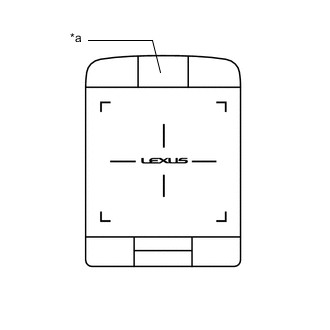
*a "MENU" Switch While pressing and holding the "MENU" switch, operate the light control switch: Off → Tail → Off → Tail → Off → Tail → Off.
-
Diagnostic mode will start and the "Service Menu" screen will be displayed.
-
-
Method 2:
-
Connect the GTS to the DLC3.
-
Turn the power switch on (IG).
-
Turn the GTS on.
-
Enter the following menus: Body Electrical / Navigation System / Utility / Map Information.
Body Electrical > Navigation System > UtilityTester Display Diagnostic Mode -
Diagnostic mode will start and the "Service Menu" screen will be displayed.
-
-
Method 3:
-
Turn the power switch on (IG).
-
Press the seek/track up panel switch 5 times and then press the seek/track down panel switch 5 times with the screen and audio turned off.
Tech Tips
-
Diagnostic mode can only be started if the above operation is completed within 15 seconds of the first press of the seek/track up panel switch.
-
If the operation is not completed within 15 seconds of the first press of the seek/track panel switch or fails, turn the screen and audio on and then off again before attempting to start diagnostic mode.
-
-
Diagnostic mode will start and the "Service Menu" screen will be displayed.
-
-
Method 4:
Note
-
If the operation fails and diagnostic mode cannot be entered, turn the multi-display assembly screen display on and off once, and then perform the procedures listed below from the first step again. (Only turning the radio receiver assembly power supply on and off will not work.)
-
Do not touch the remote touch screen except when required.
-
Since the remote touch screen may recognize a pinch in/out or flick operation if operated with 2 fingers, always use 1 finger to operate the remote touch screen in self-diagnostic mode.
-
Turn the power switch on (IG).
-
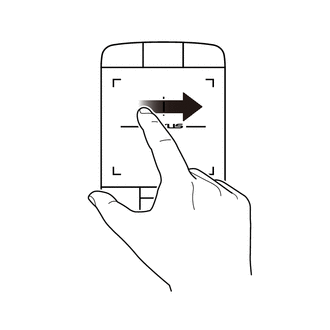
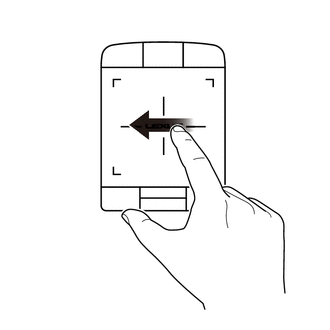
Perform a flick operation on the remote touch screen from the left to the right 5 times and then perform a flick operation from the right to left 5 times with the screen and audio turned off as shown in the illustration.
Tech Tips
-
Diagnostic mode can only be started if the above operation is completed within 15 seconds of the first flick from the left to the right.
-
If the operation is not completed within 15 seconds of the first flick from the left to the right or fails, turn the screen and audio on and then off before attempting to start diagnostic mode again.
-
Flick operations can be recognized anywhere within the touch area of the remote touch screen.
-
-
Diagnostic mode will start and the "Service Menu" screen will be displayed.
-
-
-
FAILURE DIAGNOSIS
-
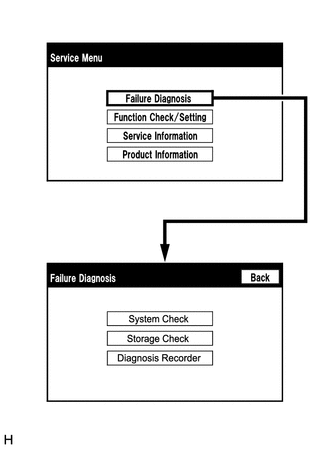
The "Failure Diagnosis" screen will be displayed by pressing the "Failure Diagnosis" switch on the "Service Menu" screen.
-
-
SYSTEM CHECK
-
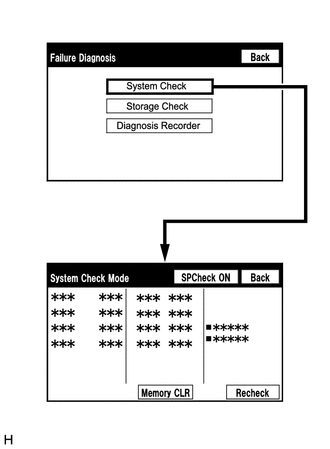
The "System Check Mode" screen will be displayed by selecting "System Check" on the "Failure Diagnosis" screen.
-
-
CHECK DTC (CHECK USING SYSTEM CHECK MODE SCREEN)
-
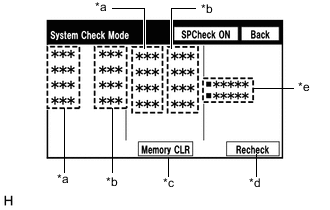
System check mode screen description
Screen Description Display Content *a: Device Name List No. 1
-
Device Name List No. 1 displays some of the devices that make up the audio and visual system.
-
The names of the components from Device Name List No. 1 are shown in the following table.
*b: Check Result Result codes for all devices are displayed. *c: Memory Clear
-
Present and history DTCs and registered connected device names are cleared.
-
Select "Memory CLR" for 3 seconds.
*d: Recheck
-
A system check will be performed again after the memory is cleared.
-
"Recheck" will dim during a system check.
*e: Device Name List No. 2
-
Device Name List No. 2 displays some of the devices that make up the audio and visual system.
-
The names of the components from Device Name List No. 2 are shown in the following table.
*a: Device Name List No. 1 Description Name Component Connection Method DCU Radio receiver assembly - DISP Multi-display assembly AVC-LAN communication line R-TOUCH remote touch (Remote operation controller assembly) Local bus communication line CAA Television camera assembly* Vehicle wire harness
-
*: w/ Parking Assist Monitor System
*b: Check Result Description Result Meaning Action OK The device does not respond with a DTC. - DETAIL The device responds with a DTC. Look up the DTC in "Unit Check Mode". NCON The device was previously present, but does not respond in diagnostic mode.
-
Check the power supply circuit of the device.
-
Check the AVC-LAN communication line of the device.
-
Check the vehicle wire harness.
NRES The device responds in diagnostic mode, but gives no DTC information.
-
Check the power supply circuit of the device.
-
Check the AVC-LAN communication line of the device.
-
Check the vehicle wire harness.
*e: Device Name List No. 2 Description Name Component Connection Method AUX/VTR No. 1 stereo jack adapter assembly Vehicle wire harness IF-BOX_ USB No. 1 stereo jack adapter assembly USB communication line -
-
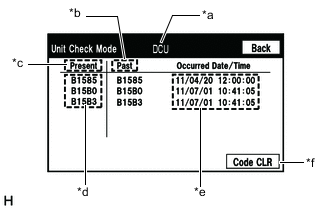
Unit check mode screen description
Screen Description Display Content *a: Device name Target device *b: History DTC Diagnostic memory results and stored DTCs are displayed. *c: Present DTC DTCs output in the service check are displayed. *d: DTC DTC (Diagnostic Trouble Code) *e: Timestamp* The time and date of history DTCs are displayed. (The year is displayed in 2-digit format.) *f: Diagnosis clear Selecting "Code CLR" for 3 seconds clears the diagnostic memory data of the target device. (Both diagnostic system check result and the displayed data are cleared.) *: w/ GPS Time Setting Function
Tech Tips
-
This screen is updated once per second.
-
A maximum of 6 DTCs can be displayed for history and present DTCs.
-
-
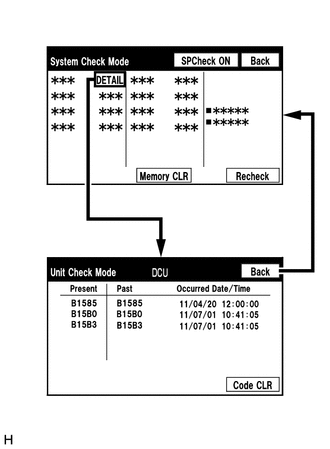
Read the system check result.
-
If the check result is "DETAIL", select the displayed check result to view the results on the "Unit Check Mode" screen and record them.
Note
A maximum of 6 DTCs can be displayed for history and present DTCs on the "Unit Check Mode" screen. Therefore, when 6 DTCs are displayed, troubleshoot those DTCs first and then check the "Unit Check Mode" screen again to see if any other DTCs are displayed.
Tech Tips
-
When all results are "OK", no DTCs are stored.
-
When "NCON" is displayed for all devices connected via the AVC-LAN, or when all device names are not displayed, check if there is a short in an AVC-LAN line or devices connected to the AVC-LAN. Repair or replace parts as necessary.
-
When proceeding to view the results of another device, select "Back" to return to the "System Check Mode" screen. Repeat the above step to view the results of other devices.
-
-
Check the details of the DTC(s).
Note
The audio and visual system outputs DTCs for the following system. When DTCs other than those in Diagnostic Trouble Code Chart for the audio and visual system are output, refer to Diagnostic Trouble Code Chart for the relevant system.
System Proceed to Parking Assist Monitor System*
-
*: w/ Parking Assist Monitor System
-
-
-
-
DTC CLEAR/RECHECK (CLEAR USING SYSTEM CHECK MODE SCREEN)
-
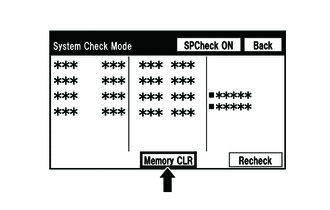
Clear DTCs
-
Select "Memory CLR" for 3 seconds.
-
Check that the check results are cleared.
Tech Tips
-
To clear the DTCs for a specific device, use the "Unit Check Mode" screen.
-
When clearing the DTCs using the "Unit Check Mode" screen, select "Code CLR" for 3 seconds.
-
-
-
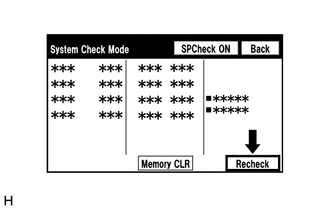
Recheck
-
Press the "Recheck" switch.
-
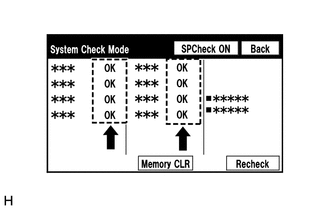
Check that all diagnostic codes are "OK" when the check results are displayed. If a result other than "OK" is displayed, perform troubleshooting again.
Tech Tips
When the DTCs are cleared using the "Unit Check Mode" screen, select "Back" to return to the "System Check Mode" screen and perform this operation.
-
-
-
FINISH DIAGNOSTIC MODE
-
Turn the power switch off.
-