RADIATOR INSTALLATION
-
INSTALL RADIATOR ASSEMBLY
-
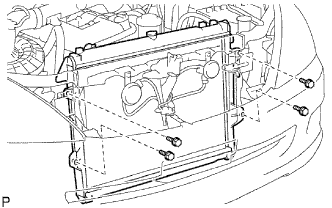
Install the radiator with the 4 bolts.
- Torque:
- 12 N*m { 122 kgf*cm, 9 ft.*lbf }
-
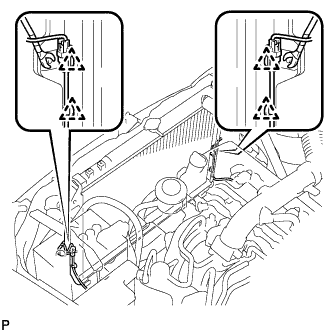
Attach the 4 clamps to the radiator side as shown in the illustration.
-
Connect the 2 airbag sensor front connectors.
-
-
INSTALL FAN SHROUD
-
Install the fan pulley to the water pump.
-
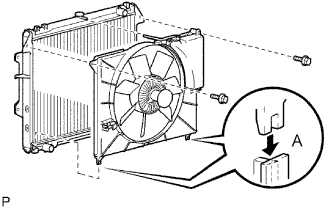
Place the shroud together with the fluid coupling fan between the radiator and engine.
Note
Be careful not to damage the radiator core.
-
Install the coupling fan to the water pump with the 4 nuts. Tighten the nuts as much as possible by hand.
-
Attach the shroud's claws to the radiator as shown in A in the illustration.
-
Install the shroud with the 2 bolts.
- Torque:
- 5.0 N*m { 51 kgf*cm, 44 in.*lbf }
-
Connect the reservoir hose to the radiator tank upper.
-
Install the drive belt Click here.
-
Tighten the 4 nuts of the fluid coupling fan.
- Torque:
- 25 N*m { 255 kgf*cm, 18 ft.*lbf }
-
-
CONNECT RADIATOR HOSE INLET
-
CONNECT RADIATOR HOSE OUTLET
-
CONNECT CABLE TO NEGATIVE BATTERY TERMINAL
-
ADD ENGINE COOLANT
-
Tighten all the plugs and fill the radiator with TOYOTA Super Long Life Coolant (SLLC).
- Torque:
- 24.5 N*m { 250 kgf*cm, 18 ft.*lbf, for cylinder block drain cock plug }
Standard capacity 7.0 liters (7.4 US qts, 6.2 Imp. qts) -
Fill the radiator reservoir with TOYOTA Super Long Life Coolant (SLLC) to the F line.
Tech Tips
-
TOYOTA vehicles are filled with TOYOTA SLLC at the factory. In order to avoid damage to the engine cooling system and other technical problems, only use TOYOTA SLLC or similar high quality ethylene glycol based non-silicate, non-amine, non-nitrite, non-borate coolant with long-life hybrid organic acid technology (coolant with long-life hybrid organic acid technology consists of a combination of low phosphates and organic acids).
-
Please contact your TOYOTA dealer for further details.
Note
Never use water as a substitute for engine coolant.
-
-
Press the inlet and outlet radiator hoses several times by hand, and then check the level of the coolant.
If the coolant level drops below the F line, add TOYOTA SLLC to the F line.
-
Install the radiator cap.
-
Bleed air from the cooling system.
-
Warm up the engine until the thermostat opens. While the thermostat is open, circulate the coolant for several minutes.
-
Maintain the engine speed at 2,500 to 3,000 rpm.
-
Press the inlet and outlet radiator hoses several times by hand to bleed air.
CAUTION:
When pressing the radiator hoses:
-
Wear protective gloves.
-
Be careful as the radiator hoses are hot.
-
Keep your hands away from the radiator fan.
-
-
-
Stop the engine and wait until the coolant cools down to ambient temperature.
CAUTION:
Do not remove the radiator cap while the engine and radiator are still hot. Pressurized, hot engine coolant and steam may be released and cause serious burns.
-
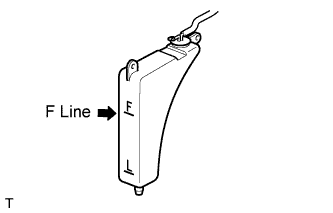
Check the coolant level in the radiator reservoir.
If the coolant level is below the L line, add SLLC to the reservoir F line.
-
-
CHECK FOR ENGINE COOLANT LEAKS
-
Check for engine coolant leaks Click here.
-
-
INSTALL RADIATOR SIDE DEFLECTOR LH
-
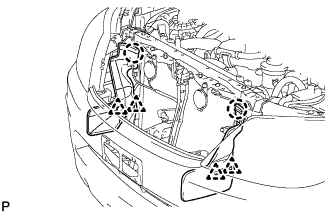
Install the deflector with the 2 clips and attach the claw.
-
-
INSTALL RADIATOR SIDE DEFLECTOR RH
-
Install the deflector with the 2 clips and attach the claw.
-
-
INSTALL RADIATOR GRILLE
-
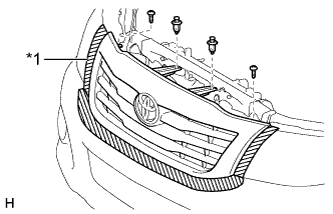
Text in Illustration *1 Protective Tape Put protective tape around the radiator grille.
-
Remove the 2 clips and 2 screws.
-
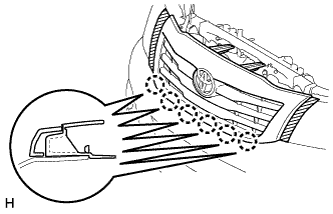
Detach the 6 claws and remove the radiator grille.
-
-
PERFORM INITIALIZATION
-
Perform initialization Click here.
Note
Certain systems need to be initialized after disconnecting and reconnecting the cable from the negative (-) battery terminal.
-