AIR CONDITIONING SYSTEM TERMINALS OF ECU
-
AIR CONDITIONING AMPLIFIER ASSEMBLY
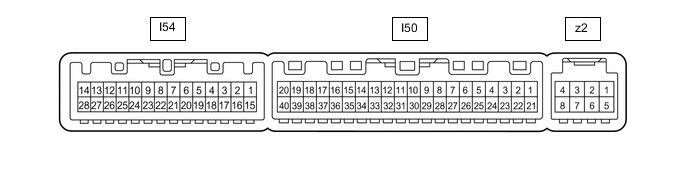
-
Disconnect the I50 air conditioning amplifier assembly connector.
-
Measure the resistance and voltage according to the value(s) in the table below.
Tech Tips
Check from the rear of the connector while it is connected to the air conditioning amplifier assembly.
Terminal No.
(Symbol)
Wiring Color Terminal Description Condition Specified Condition I50-1 (IG+) - Body ground SB - Body ground Power source (IG) Engine switch on (IG) 11 to 14 V Engine switch off Below 1 V I50-14 (GND) - Body ground W-B - Body ground Ground for main power supply Always Below 1 Ω I50-21 (B) - Body ground GR - Body ground Power source (Back-up) Engine switch off 11 to 14 V -
Reconnect the I50 air conditioning amplifier assembly connector.
-
Measure the resistance, voltage and waveform according to the value(s) in the table below.
Tech Tips
Check from the rear of the connector while it is connected to the air conditioning amplifier assembly.
Terminal No.
(Symbol)
Wiring Color Terminal Description Condition Specified Condition I50-3 (PTC2) - I50-14 (GND)*1 GR - W-B Quick heater assembly operation signal
-
Engine starts
-
Integration control and panel sub-assembly (ECO mode switch) off
-
Temperature settings: MAX HOT
-
Ambient temperature: 10°C (50°F) or lower
-
Engine coolant temperature: 64°C (147°F) or lower
-
Light control switch off
-
Blower switch: on
Below 1 V
-
Engine starts
-
Integration control and panel sub-assembly (ECO mode switch) off
-
Temperature settings: MAX HOT
-
Ambient temperature: 10°C (50°F) or lower
-
Engine coolant temperature: 64°C (147°F) or lower
-
Light control switch off
-
Blower switch: off
11 to 14 V I50-4 (ECOS) - Body ground R - Body ground Integration control and panel assembly (ECO mode switch) signal Engine switch on (IG)
Integration control and panel assembly (ECO mode switch) on
Below 1 V Engine switch on (IG)
Integration control and panel assembly (ECO mode switch) off
11 to 14 V I50-5 (TAM) - I50-13 (SG-2)*2 L - G Ambient temperature sensor signal Engine switch on (IG) (do not start the engine and electric motor)
Ambient temperature 10 °C (50 °F)
1.8 to 2.4 V Engine switch on (IG) (do not start the engine and electric motor)
Ambient temperature 15 °C (59 °F)
1.65 to 2.15 V Engine switch on (IG) (do not start the engine and electric motor)
Ambient temperature 20 °C (68 °F)
1.5 to 1.95 V Engine switch on (IG) (do not start the engine and electric motor)
Ambient temperature 25°C (77°F)
1.35 to 1.75 V Engine switch on (IG) (do not start the engine and electric motor)
Ambient temperature 30 °C (86 °F)
1.2 to 1.55 V Engine switch on (IG) (do not start the engine and electric motor)
Ambient temperature 35 °C (95 °F)
1.0 to 1.4 V Engine switch on (IG) (do not start the engine and electric motor)
Ambient temperature 40 °C (104 °F)
0.85 to 1.25 V Engine switch on (IG) (do not start the engine and electric motor)
Ambient temperature 45 °C (113 °F)
0.75 to 1.10 V Engine switch on (IG) (do not start the engine and electric motor)
Ambient temperature 50 °C (122 °F)
0.8 to 1.0 V I50-9 (PRE) - I50-10 (S5-3) BE - B Air conditioner pressure sensor signal Engine running
Air conditioning system operating
Refrigerant pressure: Abnormal pressure (higher than 3025 kPa [30.8 kgf/cm2, 439 psi])
4.73 V or higher Engine running
Air conditioning system operating
Refrigerant pressure: Abnormal pressure (below 176 kPa [1.8 kgf/cm2, 26 psi])
Below 0.62 V Engine running
Air conditioning system operating
Refrigerant pressure: Normal pressure (below 3025 kPa [30.8 kgf/cm2, 439 psi] and higher than 176 kPa [1.8 kgf/cm2, 26 psi])
0.62 to 4.73 V I50-10 (S5-3) - Body ground B - Body ground Ground for air conditioner pressure sensor, ambient temperature sensor, air conditioning lock sensor Always Below 1 Ω I50-11 (CANH) B (for LHD)
P (for RHD)
CAN communication line - - I50-12 (CANL) W CAN communication line - - I50-13 (SG-2) - Body ground G - Body ground Ground for ambient temperature sensor signal Always Below 1 Ω I50-19 (PTC3) - I50-14 (GND)*1 R - W-B Quick heater assembly operation signal
-
Engine starts
-
Integration control and panel sub-assembly (ECO mode switch) off
-
Temperature settings: MAX HOT
-
Ambient temperature: 10°C (50°F) or lower
-
Engine coolant temperature: 60°C (140°F) or lower
-
Light control switch off
-
Blower switch: on
Below 1 V
-
Engine starts
-
Integration control and panel sub-assembly (ECO mode switch) off
-
Temperature settings: MAX HOT
-
Ambient temperature: 10°C (50°F) or lower
-
Engine coolant temperature: 60°C (140°F) or lower
-
Light control switch off
-
Blower switch: off
11 to 14 V I50-22 (BLW) - Body ground R - Body ground Blower motor speed control signal Engine switch on (IG)
Blower switch LO
Pulse generation
(See Waveform 1)
I50-29 (TR) - I50-34 (SG-1) GR - V Room temperature sensor signal Engine switch on (IG)
Cabin temperature: 25°C (77°F)
1.8 to 2.2 V Engine switch on (IG)
Cabin temperature: 40°C (104°F)
1.2 to 1.6 V I50-34 (SG-1) - Body ground V - Body ground Ground for room temperature sensor Always Below 1 Ω I50-37 (LIN1) - Body ground B - Body ground LIN communication signal Engine switch on (IG) Pulse generation I50-40 (PTC1) - I50-14 (GND)*1 B - W-B Quick heater assembly operation signal
-
Engine starts
-
Integration control and panel sub-assembly (ECO mode switch) off
-
Temperature settings: MAX HOT
-
Ambient temperature: 10°C (50°F) or lower
-
Engine coolant temperature: 60°C (140°F) or lower
-
Light control switch off
-
Blower switch: on
Below 1 V
-
Engine starts
-
Integration control and panel sub-assembly (ECO mode switch) off
-
Temperature settings: MAX HOT
-
Ambient temperature: 10°C (50°F) or lower
-
Engine coolant temperature: 60°C (140°F) or lower
-
Light control switch off
-
Blower switch: off
11 to 14 V z2-2 (BUS G) - Body ground - Ground for BUS IC Always Below 1 V z2-3 (BUS) - z2-2 (BUS G) - BUS IC control signal Engine switch on (IG) Pulse generation
(See Waveform 1)
z2-4 (B BUS) - z2-2 (BUS G) - Power supply for BUS IC Always 11 to 14 V z2-5 (SGA) - Body ground GR - Body ground Ground for evaporator temperature sensor Always Below 1 V z2-6 (TEA) - z2-5 (SGA) GR - GR Evaporator temperature sensor signal Engine switch on (IG)
Evaporator temperature: 0°C (32°F)
1.7 to 2.1 V z2-6 (TEA) - z2-5 (SGA) GR - GR Evaporator temperature sensor signal Engine switch on (IG)
Evaporator temperature: 15°C (59°F)
0.9 to 1.3 V *1: w/ PTC Heater
*2: Using a thermometer, to detects the ambient temperature around the installation area of the thermistor assembly (ambient temperature sensor) is installed
-
-
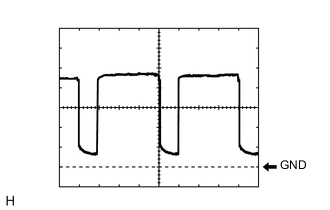
Waveform 1:
Item Content Terminal No. I50-22 (BLW) - Body ground Tool Setting 1 V/DIV., 500 μs/DIV. Vehicle Condition Engine switch on (IG)
Blower switch LO
-
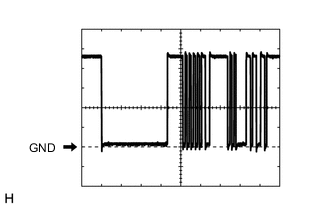
Waveform 2:
Item Content Terminal No. z2-3 (BUS) - z2-2 (BUS G) Tool Setting 2 V/DIV., 2 ms/DIV. Vehicle Condition Engine switch on (IG)
-
-
AIR CONDITIONING CONTROL ASSEMBLY

-
Disconnect the I13 air conditioning control assembly connector.
-
Measure the resistance and voltage according to the value(s) in the table below.
Tech Tips
Check from the rear of the connector while it is connected to the air conditioning control assembly.
Terminal No.
(Symbol)
Wiring Color Terminal Description Condition Specified Condition I13-5 (ACC) - I13-14 (GND) W - W-B*1
GR - W-B*2
Power source (ACC) Engine switch on (ACC) 11 to 14 V Engine switch off Below 1 V I13-7 (+B) - I13-14 (GND) L - W-B Power source (Back-up) Engine switch off 11 to 14 V I13-8 (IG+) - I13-14 (GND) LG - W-B*1
W - W-B*2
Power source (IG) Engine switch on (IG) 11 to 14 V*1
10.5 to 16 V*2
Engine switch off Below 1 V I13-14 (GND) - Body ground W-B - Body ground Ground for air conditioning control assembly Always Below 1 Ω *1: w/o Stop and Start System
*2: w/ Stop and Start System
-
Reconnect the I13 air conditioning control assembly connector.
-
Measure the waveform according to the value(s) in the table below.
Tech Tips
Check from the rear of the connector while it is connected to the air conditioning control assembly.
Terminal No.
(Symbol)
Wiring Color Terminal Description Condition Specified Condition I13-6 (LIN1) - I13-14 (GND) B - W-B LIN communication signal Engine switch on (IG) Pulse generation
-