AUDIO AND VISUAL SYSTEM(for Radio and Display Type) OPERATION CHECK
CHECK PANEL&STEERING SWITCH
Tip:The radio and display receiver assembly panel switches and steering switches are checked in the following procedure.
Illustrations may differ from the actual vehicle screen depending on the device settings and options. Therefore, some detailed areas may not be shown exactly the same as on the actual vehicle screen.
Enter diagnostic mode.
-
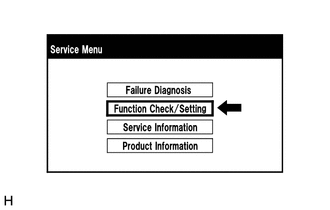
Select "Function Check/Setting" from the "Service Menu" screen.
-
*A
w/ DAB Function
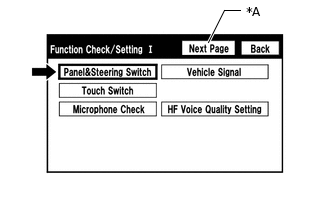
Select "Panel&Steering Switch" from the "Function Check/Setting I" screen.
-
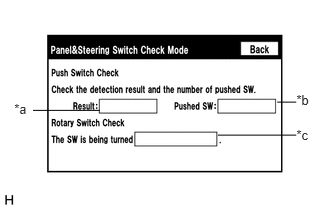
Panel&Steering Switch Check Mode
Table 1. Screen Description Display
Content
*a: Switch condition
"Pushed" is displayed when any switch is pushed
*b: Number of switches pushed
Number of switches pushed at once is displayed
If 3 or more switches are pushed at once, "More than 3" is displayed
*c: Rotary switch direction
Direction of rotary switch is displayed
Operate each switch and check that the switch conditions are correctly displayed.
Note:When the "SETUP", "APPS" or "MENU" switch is pressed and held for 3 seconds or more, diagnostic mode will be canceled.
CHECK TOUCH SWITCH
Tip:The touch switches on the screen are checked in the following procedure.
Illustrations may differ from the actual vehicle screen depending on the device settings and options. Therefore, some detailed areas may not be shown exactly the same as on the actual vehicle screen.
Enter diagnostic mode.
-
Select "Function Check/Setting" from the "Service Menu" screen.
-
*A
w/ DAB Function
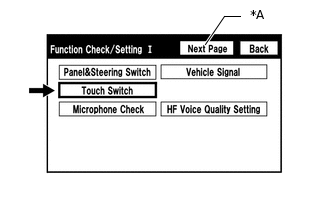
Select "Touch Switch" from the "Function Check/Setting I" screen.
-
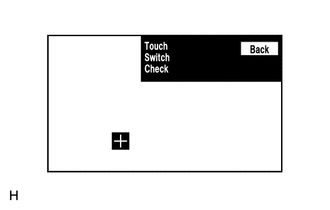
Touch Switch Check
Touch the display anywhere in the open area to perform the check when the "Touch Switch Check" screen is displayed.
Tip:A "+" mark is displayed where the display is touched.
The "+" mark remains on the display even after the finger is removed.
CHECK MICROPHONE
Tip:The microphone and microphone input level are checked in the following procedure.
Illustrations may differ from the actual vehicle screen depending on the device settings and options. Therefore, some detailed areas may not be shown exactly the same as on the actual vehicle screen.
Enter diagnostic mode.
-
Select "Function Check/Setting" from the "Service Menu" screen.
-
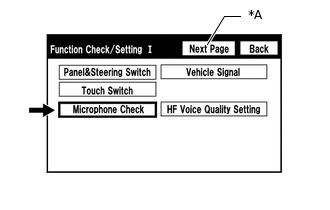
*A
w/ DAB Function
Select "Microphone Check" from the "Function Check/Setting I" screen.
-
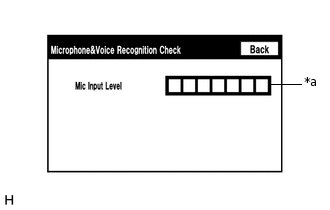
Microphone Check
Table 2. Screen Description Display
Content
*a: Microphone input level meter
Monitors the microphone input level every 0.1 seconds and displays the results in 8 different levels.
When speaking into the microphone, check that the microphone input level meter changes according to the input level.
Tip:The microphone is active at all times when this screen is displayed.
CHECK VEHICLE SIGNAL
Tip:Vehicle signals received by the radio and display receiver assembly are checked in the following procedure.
Illustrations may differ from the actual vehicle screen depending on the device settings and options. Therefore, some detailed areas may not be shown exactly the same as on the actual vehicle screen.
Enter diagnostic mode.
-
Select "Function Check/Setting" from the "Service Menu" screen.
-
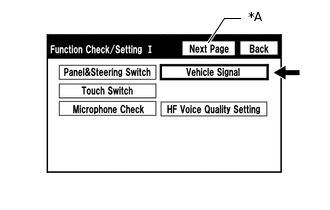
*A
w/ DAB Function
Select "Vehicle Signal" from the "Function Check/Setting I" screen.
-
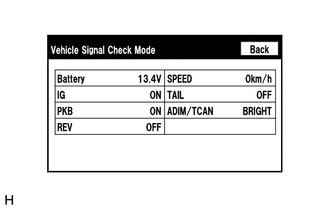
Vehicle Signal Check Mode
Table 3. Screen Description Display
Content
Battery
Battery voltage is displayed.
IG
Ignition switch ON/OFF state is displayed.
PKB
Parking brake ON/OFF state is displayed.
REV
Reverse signal ON/OFF state is displayed.
SPEED
Vehicle speed is displayed in km/h.
TAIL
Tail signal (Light control switch) ON/OFF state is displayed.
ADIM/TCAN
Brightness state DIM (with) / BRIGHT (without) is displayed.
Tip:Only items sending vehicle signals will be displayed.
This screen displays vehicle signals input to the radio and display receiver assembly.
This screen is updated once per second when vehicle input signals change.
When the "Vehicle Signal Check Mode" screen is displayed, check all the vehicle signal conditions.
CHECK HF QUALITY SETTING
Tip:The hands-free volume of a "Bluetooth" compatible phone can be adjusted using the following procedure.
Illustrations may differ from the actual vehicle screen depending on the device settings and options. Therefore, some detailed areas may not be shown exactly the same as on the actual vehicle screen.
Enter diagnostic mode.
-
Select "Function Check/Setting" from the "Service Menu" screen.
-
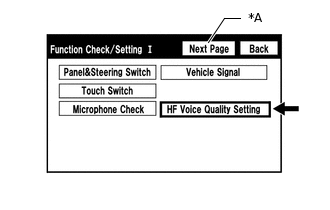
*A
w/ DAB Function
Select "HF Voice Quality Setting" from the "Function Check/Setting I" screen.
-
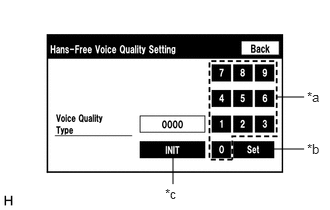
*a
Numeric keypad
*b
Setting button
*c
Reset button
Hands-Free Voice Quality Setting (Voice Quality Type adjustment)
If necessary, refer to the table below to adjust the voice quality type with the numeric keypad.
When adjusting the settings, use the number pad on the screen to input the voice quality type according to the table.
Table 4. Settings Parameter
Target Phenomenon
Voice Quality Type
Positive Effect of Changing Voice Quality
Negative Effect of Changing Voice Quality
A
(Noise)
The other party hears background noise when listening to your voice
1000
The amount of background noise the other party hears when listening to your voice is reduced
The volume of voice the other party hears when listening to your voice may temporarily drop
B
(Noise)
The other party hears a lot of background noise when listening to your voice
2000
The amount of background noise the other party hears when listening to your voice is sharply reduced
The volume of voice the other party hears when listening to your voice may temporarily drop
C
(Echo)
The other party hears weak echoes
0100
The amount of echo is reduced (low level)
Sound quality of the other party deteriorates (low level)
D
(Echo)
The other party hears strong echoes
0200
The amount of echo is reduced (high level)
Sound quality of the other party deteriorates (high level)
Table 5. Settings (When Multiple Phenomena Occurred) Parameter
Target Phenomenon
Voice Quality Type
Positive Effect of Changing Voice Quality
Negative Effect of Changing Voice Quality
A+C
The other party hears background noise and weak echoes when listening to your voice
1100
The amount of background noise the other party hears when listening to your voice is reduced
The amount of echo is reduced (low level)
The volume of voice may drop temporarily
Sound quality of the other party deteriorates (low level)
A+D
The other party hears background noise and strong echoes when listening to your voice
1200
The amount of background noise the other party hears when listening to your voice is reduced
The amount of echo is reduced (high level)
The volume of voice may drop temporarily
Sound quality of the other party deteriorates (high level)
B+C
The other party hears a lot of background noise and weak echoes when listening to your voice
2100
The amount of background noise the other party hears when listening to your voice is sharply reduced
The amount of echo is reduced (low level)
The volume of voice may drop temporarily
Sound quality of the other party deteriorates (low level)
B+D
The other party hears a lot of background noise and strong echoes when listening to your voice
2200
The amount of background noise the other party hears when listening to your voice is sharply reduced
The amount of echo is reduced (high level)
The volume of voice may drop temporarily
Sound quality of the other party deteriorates (high level)
Tip:The default value is "0000".
Settings will be applied when the normal screen is returned to.
If voice quality type values that are not in the table are input, the setting will not be applied and a positive effect may not be gained.
If the quality of phone calls decreases due to the changed settings, return the settings to "0000" by pressing the "INIT" switch.
CHECK SPEAKER
Tip:This function is used when checking the speaker wiring and whether the speakers are functioning properly.
Illustrations may differ from the actual vehicle screen depending on the device settings and options. Therefore, some detailed areas may not be shown exactly the same as on the actual vehicle screen.
Enter diagnostic mode.
-
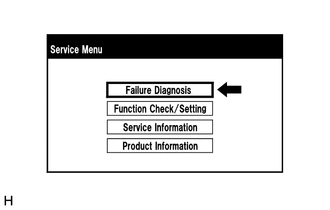
Select "Failure Diagnosis" from the "Service Menu" screen.
-
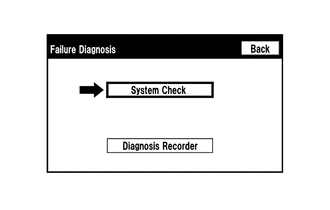
Select "System Check" from the "Failure Diagnosis" screen.
-
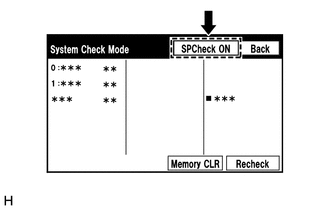
Select "SPCheck ON" from the "System Check Mode" screen.
Check the speaker wiring and check that the speakers are functioning properly.
Tip:Check that each speaker outputs sound from the selected audio source properly.
"SPCheck OFF" is displayed during the speaker check.
Sound can be heard from the speakers around the vehicle in order beginning from a speaker on the front side.
Sound stops when any of the following conditions are met:
The "SPCheck OFF" switch is pressed.
The ignition switch is turned off.
Diagnostic mode is turned off.
The screen is changed to another screen.
Audio mode is turned off.
CHECK DAB RECEPTION (w/ DAB Function)
Tip:The reception condition of DAB (Digital Audio Broadcast) can be checked.
Illustrations may differ from the actual vehicle screen depending on the device settings and options. Therefore, some detailed areas may not be shown exactly the same as on the actual vehicle screen.
Enter diagnostic mode.
-
Select "Function Check/Setting" from the "Service Menu" screen.
-
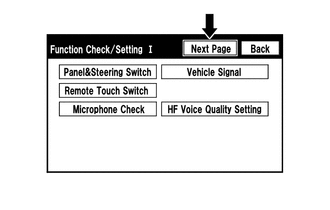
Select "Next Page" from the "Function Check/Setting I" screen.
-
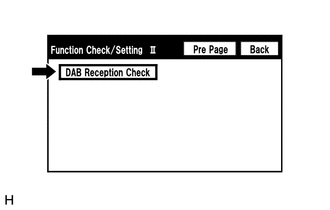
Select "DAB Reception Check" from the "Function Check/Setting II" screen.
-
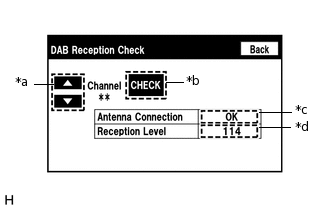
DAB Reception Check
Table 6. *a: Channel Change Switch Description Display
Content
Up or down button
Enables the channel to be changed to the one to be checked
Table 7. *b: Check Switch Description Display
Condition
Content
CHECK
Before/after check
Starts checking
STOP
During check
Stops checking
Table 8. *c: Antenna Connection Check Result Description Display
Content
OK
Connected properly
NG
Not connected properly
-
Not equipped with DAB antenna
Table 9. *d: DAB Tuner Reception Level Check Result Description Display
Content
Black
Good reception
Red
Poor reception
-
Not equipped with DAB antenna
-
Tip:
This function is used to check the cause when the radio and display receiver assembly screen is blacked out.
CHECK SOFTWARE ERROR HISTORY
Check software error history.
Connect the GTS to the DLC3.
Engine start.
Turn the GTS on.
Enter the following menus: Body Electrical / Navigation System / Utility / Software Error History.
Body Electrical > Navigation System > Utility
Tester Display
Software Error History
When an item is stored for Software Error History, record it before repairing the radio and display receiver assembly.
Table 10. Software Error History Screen Description Error Description
Trigger
Detail
Software Reset
Navi Microcomputer
Hexadecimal Number
Audio Microcomputer
CAN Microcomputer
No Video Signal
Front Monitor
Rear Monitor
MOST Cold Restart
Always
Tip:Software Error History can store up to 5 history data items. If a new software error occurs when 5 data items have already been stored, the oldest data is cleared and the new data is stored.
If an error that is unsupported by the GTS occurs, a "-" is displayed for the display items.
Clear software error history.
When DTCs are cleared using any of the following operations, Software Error History will be cleared as well.
Cleared using the GTS.
Cleared using the system check mode screen.
Cleared using the unit check mode screen.
CHECK OPTICAL DISC ERROR HISTORY (for 6.1 Inch Display)
Tip:This function is used to check the cause of an optical disc error.
Check optical disc error history.
Connect the GTS to the DLC3.
Engine start.
Turn the GTS on.
Enter the following menus: Body Electrical / Navigation System / Utility / Optical Disc Error History.
Body Electrical > Navigation System > Utility
Tester Display
Optical Disc Error History
When an item is stored for Optical Disc Error History, record it before proceeding with troubleshooting.
Table 11. Optical Disc Error History Screen Description Display
Content
Error Type
Displays the type of error.
Device
Displays the malfunctioning device.
Date
Displays the date and time that the malfunction occurred.
Table 12. "Error Type" Screen Description Error Type
Detection Condition
Action
Read Error
When a disc read error occurs.
Proceed to next suspected area shown in Problem Symptoms Table
Click here
Disc damaged/upside down/dirty
When it is determined that any of the following is the cause of the disc read error:
The disc cannot be read.
The disc cannot be read because of dirt or scratches.
The disc cannot be read because it is inserted upside down.
Cannot determine disc type
An unsuitable disc is inserted.
DPS error
When an error occurs while decoding MP3/WMA files.
Some files are corrupt
When MP3/WMA files cannot be played back because they are unsupported.
Even though the file extensions are MP3 or WMA, files cannot be played back because the header information cannot be read.
Some files cannot be found
When a disc without music data is played back.
When there are no playable MP3/WMA files.
Copy protection violation
When a file with copyright protection that cannot be played back is played back.
Table 13. "Device" Screen Description Device
Component
DVD-P
Not available
CD-P
Radio and display receiver assembly
R-Seat DVD-P
Not available
Tip:Optical Disc Error History can store up to 7 history data items. If a new optical disc error occurs when 7 data items have already been stored, the oldest data is cleared and the new data is stored.
If an error that is unsupported by the GTS occurs, a "-" or blank is displayed for the display items.
Clear optical disc error history.
When DTCs are cleared using any of the following operations, Optical Disc Error History will be cleared as well.
Cleared using the GTS.
Cleared using the system check mode screen.
Cleared using the unit check mode screen.
CHECK VIDEO DEVICE CONNECTION CHECK
Tip:This function is used to detect disconnection of the video devices.
Check Video Device Connection Check.
Connect the GTS to the DLC3.
Turn the ignition switch to ON.
Turn the GTS on.
Enter the following menus: Body Electrical / Navigation System / Utility / Video Device Connection Check.
Body Electrical > Navigation System > Utility
Tester Display
Video Device Connection Check
When an item is stored for Video Device Connection Check, record it before proceeding with troubleshooting.
Tip:DTCs are stored when errors are detected.
Depending on the vehicle, some of the items are not displayed on the "Error Detected Image Line (Type)" screen.
Table 14. Video Device Connection Check Screen Description Error Detected Image Line (Type)
Areas to be Checked
H/U - > Separate Display (GVIF)
Not available
H/U - > Full RSE (GVIF)
Not available
RSE - > Seat Back Display RH (GVIF)
Not available
RSE - > Seat Back Display LH (GVIF)
Not available
Rear Camera - > H/U (NTSC)*1
NTSC video signal between the radio and display receiver assembly and television camera assembly
IPA/BGM/PVM ECU - > Separate Display (GVIF)
Not available
IPA/BGM/PVM ECU - > H/U (NTSC)*2
NTSC video signal between the radio and display receiver assembly and parking assist ECU
IPA/BGM/PVM ECU - > H/U (GVIF)
Not available
*1: w/ Parking Assist Monitor System (for Camera built-in ECU)
*2: w/ Panoramic View Monitor System
Clear video device connection check.
When DTCs are cleared using any of the following operations, Video Device Connection Check will be cleared as well.
Cleared using the GTS.
Cleared using the system check mode screen.
Cleared using the unit check mode screen.