EXHAUST SYSTEM
-
CONSTRUCTION
-
The exhaust pipes are made of stainless steel for improved rust resistance.
-
A thin-wall, ceramic type TWC is used.
-
A main muffler is used to ensure engine performance and reduce exhaust noise.
-
A ball joint is used to join the exhaust manifold converter sub-assembly and front exhaust pipe assembly, and another ball joint is used to join the front exhaust pipe assembly and center exhaust pipe assembly. As a result, in-vehicle sound has been muffled, vibration has been minimized, and weight reduction has been realized.
Figure 1. Models with Single Tail Exhaust Pipe Type
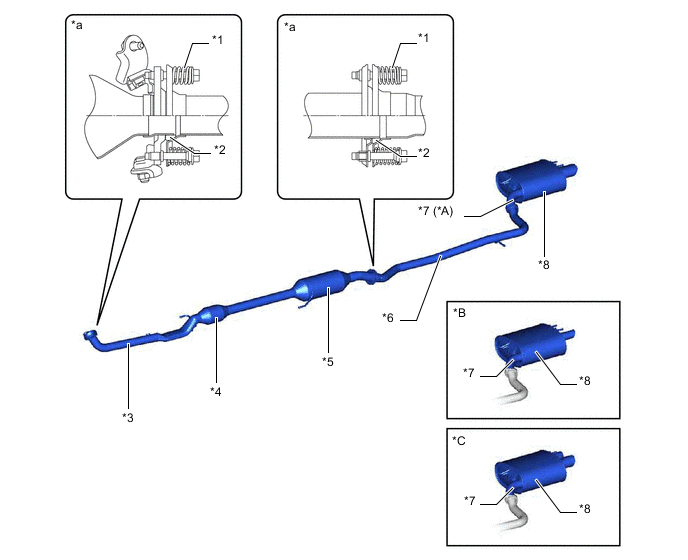
*A Models with Single Tail Exhaust Pipe Baffle *B Models without Tail Exhaust Pipe Baffle *C Models with Dual Tail Exhaust Pipe Baffle - - *1 Compression Spring *2 Gasket *3 Front Exhaust Pipe Assembly *4 TWC *5 Sub Muffler *6 Center Exhaust Pipe Assembly *7 Tail Exhaust Pipe Assembly *8 Main Muffler *a Ball Joint - - Figure 2. Models with Dual Tail Exhaust Pipe Type
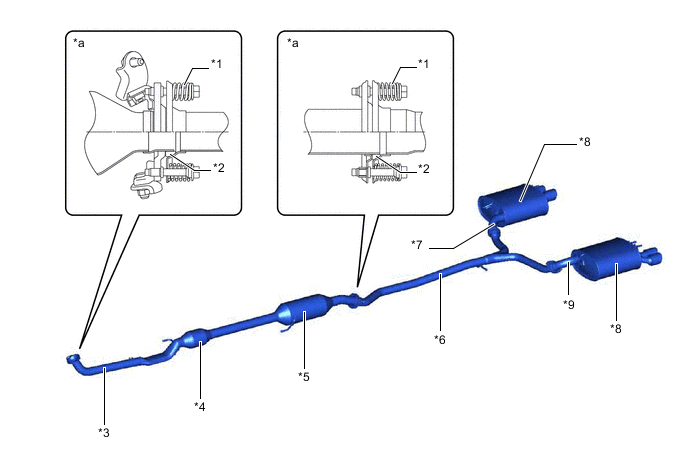
*1 Compression Spring *2 Gasket *3 Front Exhaust Pipe Assembly *4 TWC *5 Sub Muffler *6 Center Exhaust Pipe Assembly *7 Tail Exhaust Pipe Assembly *8 Main Muffler *9 Tail Exhaust Pipe LH - - *a Ball Joint - -
-
-
OPERATION
-
2-Way Exhaust Control System
-
In order to maintain quietness, and allow for high exhaust efficiency and high engine power output, a 2-way exhaust system is used for the main muffler. A control valve is used inside the main muffler to open the exhaust gas passage using the exhaust gas pressure. The control valve closes at low engine speeds by means of a return spring.
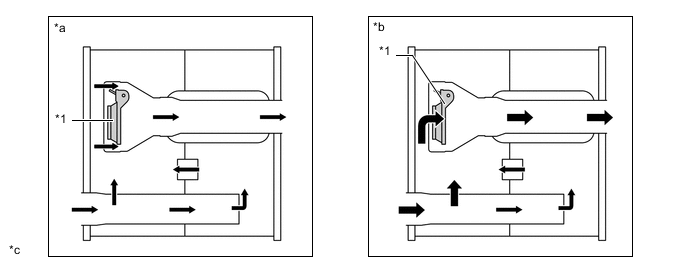
*1 Control Valve - - *a Low Engine Speed (Control Valve Closes) *b High Engine Speed (Control Valve Opens) *c The illustrations shown are examples only. - - 
Exhaust Gas - -
-
-