STOP AND START SYSTEM(for V35A-FTS), Diagnostic DTC:P323A19
| DTC Code | DTC Name |
|---|---|
| P323A19 | Backup Boost Converter "A" Circuit Current Above Threshold |
DESCRIPTION
A backup boost converter is built into the engine stop and start ECU.
The backup boost converter helps maintain battery voltage to prevent various functions from failing if power source voltage supplied from the backup boost converter drops due to the high electrical load when the engine is restarted by stop and start control.
The backup boost converter helps maintain the power source voltage if the battery voltage drops due to the high electrical load when the engine is restarted by stop and start control.
Tech Tips
A relay function and fuse function are provided in the backup boost converter.
If there is a malfunction in any of the electrical system circuits connected to the backup boost converter, the fuse and relay functions shut off the malfunctioning circuit to protect other circuits (remains shut off until next trip).
When the electrical system circuit is shut off, power to the circuit is cut off, causing any systems connected to the circuit to be disabled.
The fuse function is reset* when the engine switch is turned off. If the malfunction still exists in the electrical system circuit that has been shut off by the relay function, it will be shut off again by the relay and fuse functions the next time the engine switch turned on (IG).
*: A semiconductor fuse self resets according to electric signal.
-
Electronically controlled brake system
-
Power steering system
-
Dynamic radar cruise control system
-
Lane departure alert system
-
Air conditioning system
-
CAN communication system (Network gateway ECU)
-
Blind spot monitor system
-
Meter / Gauge system
-
Remote operation controller assembly
-
Telematics System
-
Tire pressure warning system
-
Entry and start system (w/ Entry and Start System)
-
Electric parking brake system
-
Air suspension system
-
Variable gear ratio steering system
-
Dynamic rear steering
-
Parking support alert system
The backup boost converter supplies power to:
| DTC No. | Detection Item | DTC Detection Condition | Trouble Area | Warning Indicate | Memory | Note |
|---|---|---|---|---|---|---|
| P323A19 | Backup Boost Converter "A" Circuit Current Above Threshold | The following condition continues for 1 second or more (1 trip detection logic):
|
|
Blinks | DTC stored | SAE Code: P323A |
CONFIRMATION DRIVING PATTERN
-
CONFIRMATION AFTER TROUBLESHOOTING
Tech Tips
-
If the cable is disconnected from the battery terminal, stop and start control is prohibited until refresh charge is completed.
In this case, let the vehicle idle to complete the refresh charge. The refresh charge is complete when the Data List item Status of Battery Charge Control changes from "Refresh Charge Mode". (Usually, idling the engine for 5 to 60 minutes with the battery fluid temperature at 11°C (52°F) or higher, the refresh charge will be completed.)
-
If the GTS is not available and the Data List item Status of Battery Charge Control cannot be checked, charge the battery by idling the engine for approximately 5 to 60 minutes or driving the vehicle, and then drive the vehicle and check that stop and start control operates.
If the engine is started with the hood open, the system determines that a jump start has occurred. Therefore, make sure that the hood is closed before starting the engine and driving the vehicle.
-
After the refresh charge completes, turn the engine switch off, wait for at least 30 seconds, and then start the engine again. If the vehicle enters refresh charge mode again while the engine is idling, the initial refresh charge did not properly complete, so wait for the refresh charge to complete.
-
Allow the engine to idle for 3 minutes after it is warmed up and check that the engine idle speed is within 50 rpm of the target idle speed.
-
Connect the GTS to the DLC3.
-
Turn the engine switch on (IG).
-
Turn the GTS on.
-
Clear the DTCs.
Powertrain > Stop and Start > Clear DTCs -
Start the engine and warm it up.
-
Drive the vehicle at 7 km/h (4.3 mph) or more.
CAUTION:
When performing Confirmation Driving Pattern, obey all speed limits and traffic laws.
-
Depress the brake pedal and stop the vehicle.
-
Keep the engine stopped by stop and start control for 1 second or more. (Keep the shift lever in D.)
-
Release the brake pedal with the shift lever in D to start the engine.
Tech Tips
If the engine cranks slowly when the engine is restarted, it can be determined that the battery voltage is low.
-
Check that DTCs are not output.
Powertrain > Stop and Start > Trouble Codes
-
-
STOP AND START SYSTEM OPERATION CHECK
Tech Tips
-
If the cable is disconnected from the battery terminal, stop and start control is prohibited until refresh charge is completed.
In this case, let the vehicle idle to complete the refresh charge. The refresh charge is complete when the Data List item Status of Battery Charge Control changes from "Refresh Charge Mode". (Usually, idling the engine for 5 to 60 minutes with the battery fluid temperature at 11°C (52°F) or higher, the refresh charge will be completed.)
-
If the GTS is not available and the Data List item Status of Battery Charge Control cannot be checked, charge the battery by idling the engine for approximately 5 to 60 minutes or driving the vehicle, and then drive the vehicle and check that stop and start control operates.
If the engine is started with the hood open, the system determines that a jump start has occurred. Therefore, make sure that the hood is closed before starting the engine and driving the vehicle.
-
After the refresh charge completes, turn the engine switch off, wait for at least 30 seconds, and then start the engine again. If the vehicle enters refresh charge mode again while the engine is idling, the initial refresh charge did not properly complete, so wait for the refresh charge to complete.
-
Start the engine and warm it up.
-
Turn the air conditioning system off.
-
Drive the vehicle at 7 km/h (4.3 mph) or more.
CAUTION:
When performing Confirmation Driving Pattern, obey all speed limits and traffic laws.
-
Depress the brake pedal and stop the vehicle.
-
Allow the engine to stop by stop and start control. (Keep the shift lever in D.)
-
Release the brake pedal with the shift lever in D to start the engine.
-
WIRING DIAGRAM
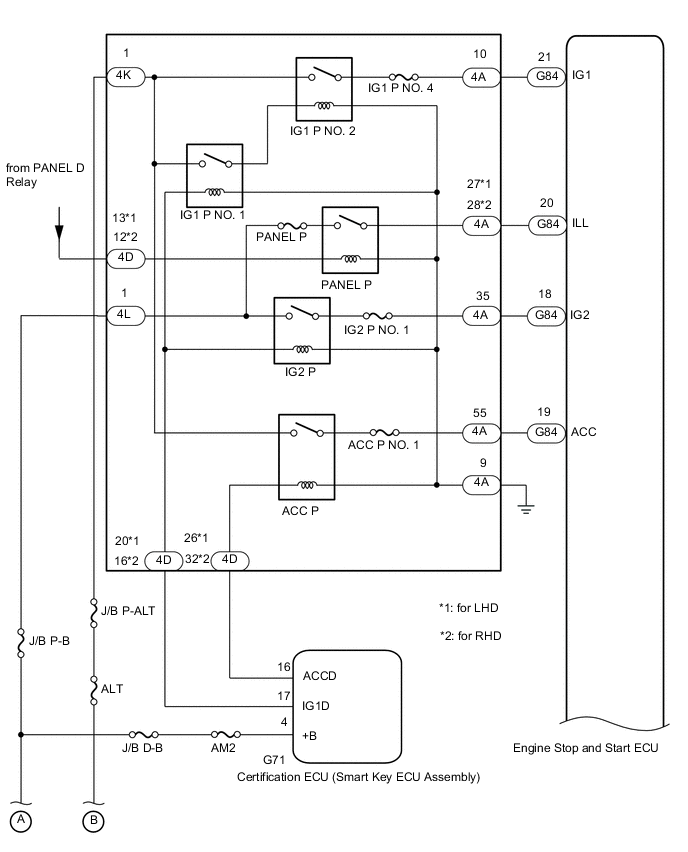
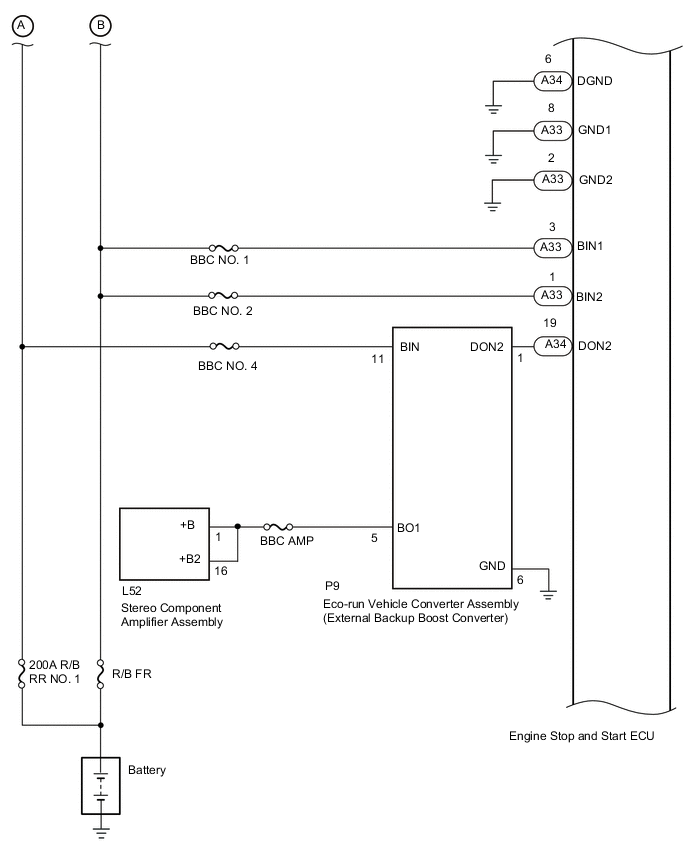
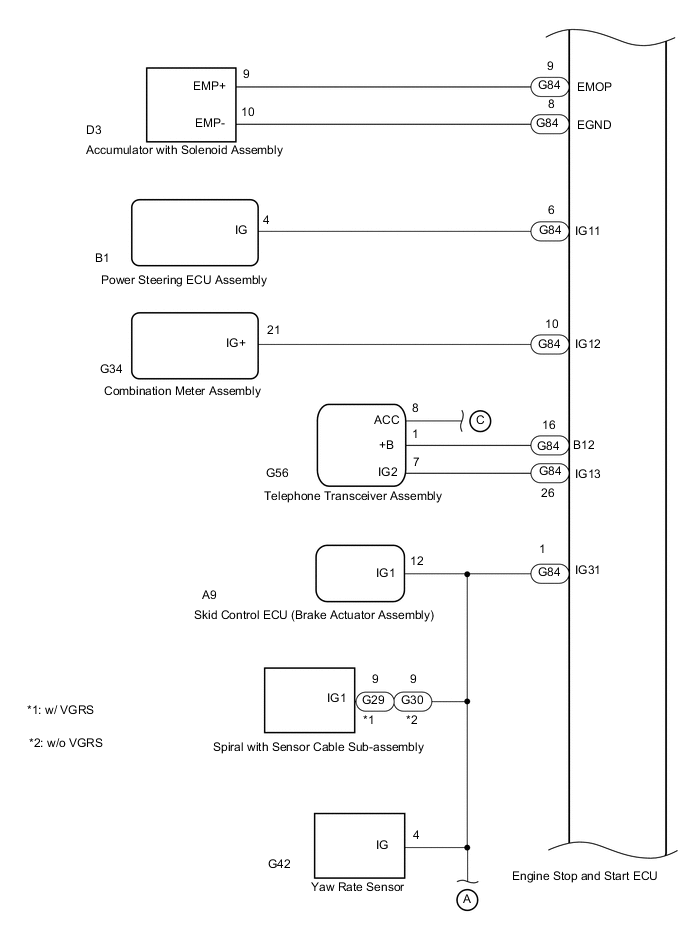
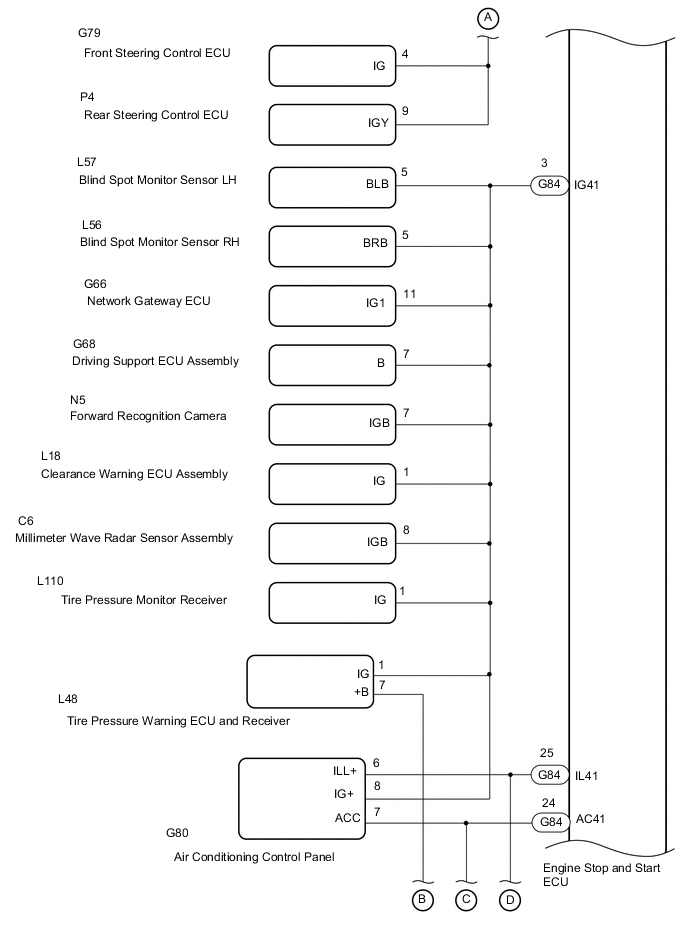
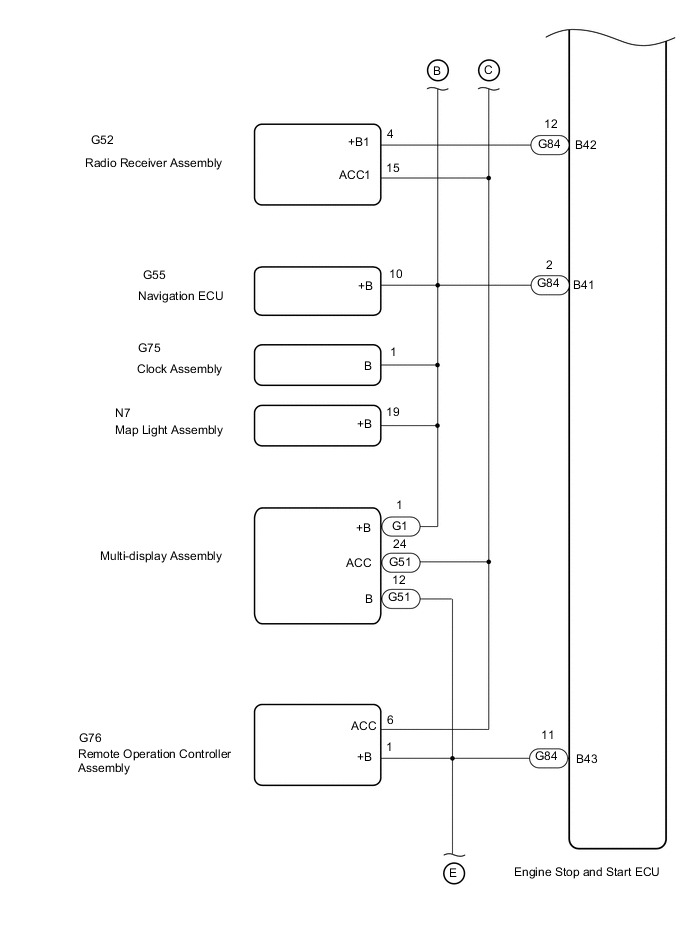
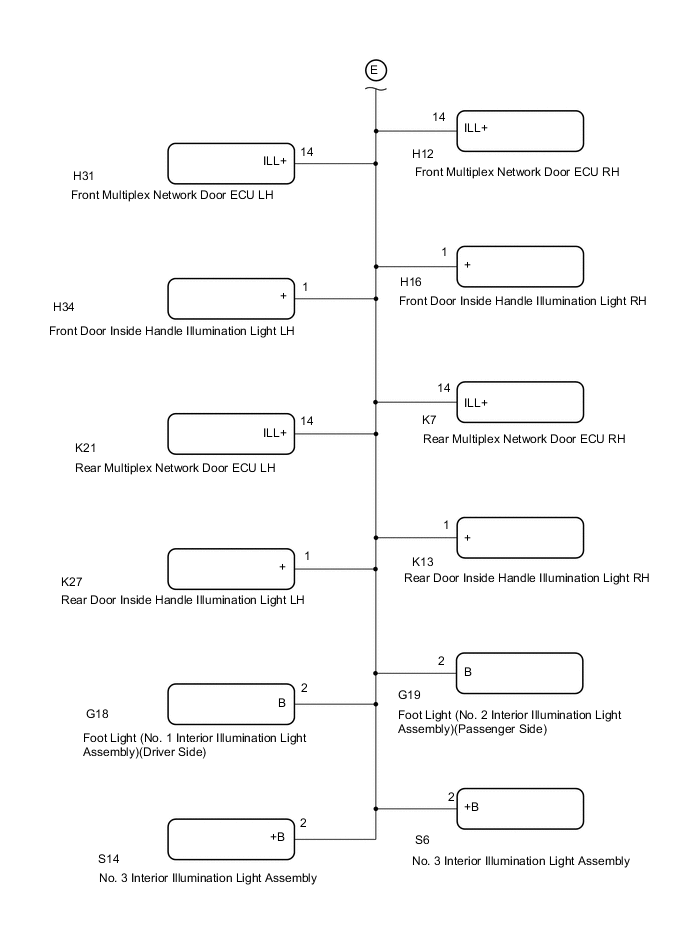
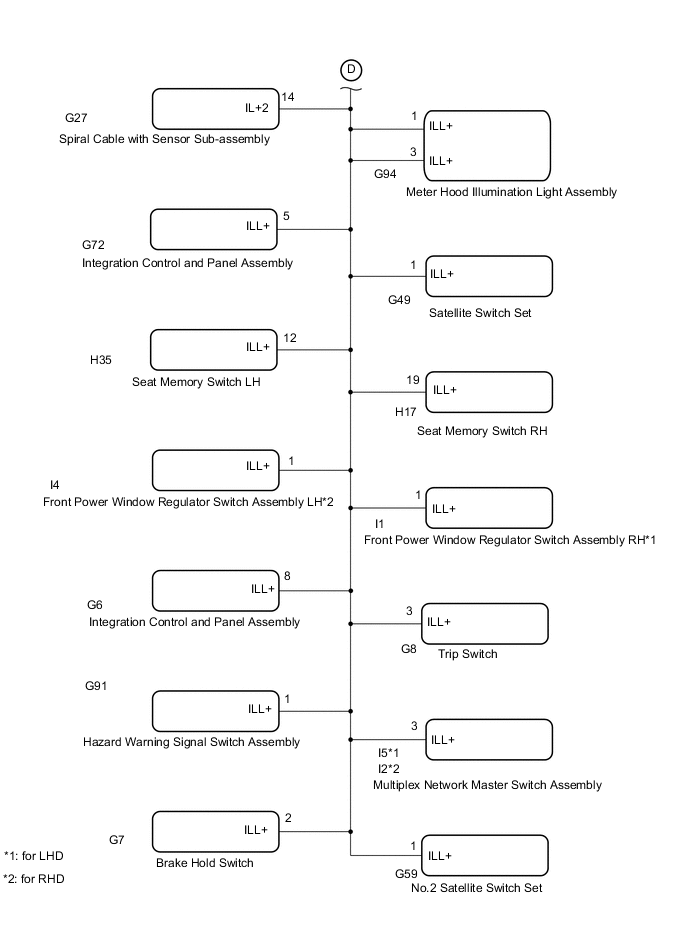
CAUTION / NOTICE / HINT
Note
-
Before replacing the engine stop and start ECU, read the number of starter operations and write it into a new engine stop and start ECU.
-
After replacing the engine stop and start ECU or air conditioning amplifier assembly, reset and perform learning of the air conditioning information in the engine stop and start ECU.
-
After replacing the engine stop and start ECU or airbag sensor assembly, clear and calibrate the deceleration sensor zero point in the engine stop and start ECU.
-
Inspect the fuses for circuits related to this system before performing the following procedure.
Tech Tips
-
If electrical load from additional devices installed to the vehicle (aftermarket audio system, etc.) is applied to the B41, B42, B43 or IG41 terminal in the engine stop and start ECU, the fuse function of the backup boost converter may operate.
If the fuse function of the backup boost converter operates, any systems connected to the B41, B42, B43 or IG41 terminal in the engine stop and start ECU will not operate.
-
DTCs for the stop and start system are not cleared even if the malfunction has been repaired. After repairing the malfunction, be sure to clear the DTCs.
-
Using the GTS, read the freeze frame data before troubleshooting. System condition information is recorded as freeze frame data the moment a DTC is stored. This information can be useful when troubleshooting.
PROCEDURE
-
CHECK HARNESS AND CONNECTOR (ENGINE STOP AND START ECU - BBC NO. 1 FUSE AND BBC NO. 2 FUSE)
-
Disconnect the engine stop and start ECU connector.
-
Remove the BBC NO. 1 fuse and BBC NO. 2 fuse from the No. 1 engine room relay block and junction block.
-
Measure the resistance according to the value(s) in the table below.
Standard Resistance Tester Connection Condition Specified Condition A33-1 (BIN2) - BBC NO. 2 fuse terminal 2 Always Below 1 Ω A33-3 (BIN1) - BBC NO. 1 fuse terminal 2 Always Below 1 Ω A33-1 (BIN2) or BBC NO. 2 fuse terminal 2 - Body ground and other terminals Always 10 kΩ or higher A33-3 (BIN1) or BBC NO. 1 fuse terminal 2 - Body ground and other terminals Always 10 kΩ or higher Result Proceed to OK NG
NG 
REPAIR OR REPLACE HARNESS OR CONNECTOR
OK 
-
-
CHECK HARNESS AND CONNECTOR (ENGINE STOP AND START ECU - EACH ECU OR SENSOR)
-
Disconnect the engine stop and start ECU connector.
-
Disconnect the L57 blind spot monitor sensor LH connector. (w/ Blind Spot Monitor System)
-
Disconnect the L56 blind spot monitor sensor RH connector. (w/ Blind Spot Monitor System)
-
Disconnect the G66 network gateway ECU connector.
-
Disconnect the G68 driving support ECU assembly connector. (w/ Dynamic Radar Cruise Control System)
-
Disconnect the N5 forward recognition camera connector. (w/ Lane Departure Alert System)
-
Disconnect the L18 clearance warning ECU assembly connector.
-
Disconnect the C6 millimeter wave radar sensor assembly connector.
-
Disconnect the L110 tire pressure monitor receiver connector. (Tire Pressure Warning System)
-
Disconnect the L48 tire pressure warning ECU and receiver connector. (Tire Pressure Warning System)
-
Disconnect the G80 air conditioning control assembly connector.
-
Disconnect the G55 navigation ECU connector. (w/ Navigation System)
-
Disconnect the G75 clock assembly connector.
-
Disconnect the N7 map light assembly connector.
-
Disconnect the G1 and G51 multi-display assembly connector.
-
Disconnect the G52 radio receiver assembly connector.
-
Disconnect the G76 remote operation controller assembly connector.
-
Disconnect the H12 front multiplex network door ECU RH connector.
-
Disconnect the H16 front door inside handle illumination light RH connector.
-
Disconnect the H31 front multiplex network door ECU LH connector.
-
Disconnect the H34 front door inside handle illumination light LH connector.
-
Disconnect the K7 rear multiplex network door ECU RH connector.
-
Disconnect the K13 rear door inside handle illumination light RH connector.
-
Disconnect the K21 rear multiplex network door ECU LH connector.
-
Disconnect the K27 rear door inside handle illumination light LH connector.
-
Disconnect the G19 front foot light (No. 2 interior illumination light assembly) (Passenger Side) connector.
-
Disconnect the G18 front foot light (No. 1 interior illumination light assembly) (Driver Side) connector.
-
Disconnect the S6 No. 3 interior illumination light assembly connector.
-
Disconnect the S14 No. 3 interior illumination light assembly connector.
-
Measure the resistance according to the value(s) in the table below.
Standard Resistance Tester Connection Condition Specified Condition G84-3 (IG41) - L57-5 (BLB)*1 Always Below 1 Ω G84-3 (IG41) - L56-5 (BRB)*1 Always Below 1 Ω G84-3 (IG41) - G66-11 (IG1) Always Below 1 Ω G84-3 (IG41) - G68-7 (B)*2 Always Below 1 Ω G84-3 (IG41) - N5-7 (IGB)*3 Always Below 1 Ω G84-3 (IG41) - L18-1 (IG) Always Below 1 Ω G84-3 (IG41) - C6-8 (IGB) Always Below 1 Ω G84-3 (IG41) - L110-1 (IG) Always Below 1 Ω G84-3 (IG41) - L48-1 (IG) Always Below 1 Ω G84-3 (IG41) - G80-8 (IG+) Always Below 1 Ω G84-2 (B41) - L48-7 (+B) Always Below 1 Ω G84-2 (B41) - G55-10 (+B) Always Below 1 Ω G84-2 (B41) - G75-1 (B) Always Below 1 Ω G84-2 (B41) - N7-19 (+B) Always Below 1 Ω G84-2 (B41) - G1-1 (+B) Always Below 1 Ω G84-12 (B42) - G52-4 (+B1) Always Below 1 Ω G84-11 (B43) - G51-12 (B) Always Below 1 Ω G84-11 (B43) - G76-1 (+B) Always Below 1 Ω G84-11 (B43) - H12-14 (ILL+) Always Below 1 Ω G84-11 (B43) - H16-1 (+) Always Below 1 Ω G84-11 (B43) - H31-14 (ILL+) Always Below 1 Ω G84-11 (B43) - H34-1 (+) Always Below 1 Ω G84-11 (B43) - K7-14 (ILL+) Always Below 1 Ω G84-11 (B43) - K13-1 (+) Always Below 1 Ω G84-11 (B43) - K21-14 (ILL+) Always Below 1 Ω G84-11 (B43) - K27-1 (+) Always Below 1 Ω G84-11 (B43) - G19-2 (B) Always Below 1 Ω G84-11 (B43) - G18-2 (B) Always Below 1 Ω G84-11 (B43) - S6-2 (+B) Always Below 1 Ω G84-11 (B43) - S14-2 (+B) Always Below 1 Ω G84-3 (IG41) or L57-5 (BLB)*1 - Body ground and other terminals Always 10 kΩ or higher G84-3 (IG41) or L56-5 (BRB)*1 - Body ground and other terminals Always 10 kΩ or higher G84-3 (IG41) or G66-11 (IG1) - Body ground and other terminals Always 10 kΩ or higher G84-3 (IG41) or G68-7 (B)*2 - Body ground and other terminals Always 10 kΩ or higher G84-3 (IG41) or N5-7 (IGB)*3 - Body ground and other terminals Always 10 kΩ or higher G84-3 (IG41) or L18-1 (IG) - Body ground and other terminals Always 10 kΩ or higher G84-3 (IG41) or C6-8 (IGB) - Body ground and other terminals Always 10 kΩ or higher G84-3 (IG41) or L110-1 (IG) - Body ground and other terminals Always 10 kΩ or higher G84-3 (IG41) or L48-1 (IG) - Body ground and other terminals Always 10 kΩ or higher G84-3 (IG41) or G80-8 (IG+) - Body ground and other terminals Always 10 kΩ or higher G84-2 (B41) or L48-7 (+B) - Body ground and other terminals Always 10 kΩ or higher G84-2 (B41) or G55-10 (+B) - Body ground and other terminals Always 10 kΩ or higher G84-2 (B41) or G75-1 (B) - Body ground and other terminals Always 10 kΩ or higher G84-2 (B41) or N7-19 (+B) - Body ground and other terminals Always 10 kΩ or higher G84-2 (B41) or G1-1 (+B) - Body ground and other terminals Always 10 kΩ or higher G84-12 (B42) or G52-4 (+B1) - Body ground and other terminals Always 10 kΩ or higher G84-11 (B43) or G51-12 (B) - Body ground and other terminals Always 10 kΩ or higher G84-11 (B43) or G76-1 (+B) - Body ground and other terminals Always 10 kΩ or higher G84-11 (B43) or H12-14 (ILL+) - Body ground and other terminals Always 10 kΩ or higher G84-11 (B43) or H16-1 (+) - Body ground and other terminals Always 10 kΩ or higher G84-11 (B43) or H31-14 (ILL+) - Body ground and other terminals Always 10 kΩ or higher G84-11 (B43) or H34-1 (+) - Body ground and other terminals Always 10 kΩ or higher G84-11 (B43) or K7-14 (ILL+) - Body ground and other terminals Always 10 kΩ or higher G84-11 (B43) or K13-1 (+) - Body ground and other terminals Always 10 kΩ or higher G84-11 (B43) or K21-14 (ILL+) - Body ground and other terminals Always 10 kΩ or higher G84-11 (B43) or K27-1 (+) - Body ground and other terminals Always 10 kΩ or higher G84-11 (B43) or G19-2 (B) - Body ground and other terminals Always 10 kΩ or higher G84-11 (B43) or G18-2 (B) - Body ground and other terminals Always 10 kΩ or higher G84-11 (B43) or S6-2 (+B) - Body ground and other terminals Always 10 kΩ or higher G84-11 (B43) or S14-2 (+B) - Body ground and other terminals Always 10 kΩ or higher
-
*1: w/ Blind Spot Monitor System (w/ Air Suspension System)
-
*2: w/ Dynamic Radar Cruise Control System
-
*3: w/ Lane Departure Alert System
Result Proceed to OK NG -
NG
REPAIR OR REPLACE HARNESS OR CONNECTOR
OK
-
-
CHECK ENGINE STOP AND START ECU
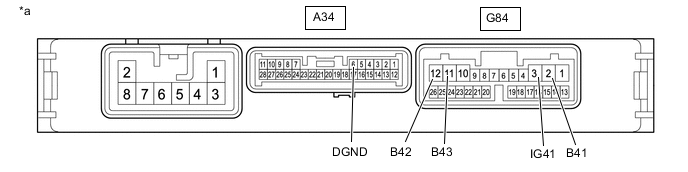
*a Component without harness connected
(Engine Stop and Start ECU)
- -
-
Disconnect the engine stop and start ECU connectors.
-
Measure the resistance according to the value(s) in the table below.
Standard Resistance Tester Connection Condition Specified Condition G84-2 (B41) - A34-6 (DGND) Always 10 kΩ or higher G84-3 (IG41) - A34-6 (DGND) Always 10 kΩ or higher G84-11 (B43) - A34-6 (DGND) Always 10 kΩ or higher G84-12 (B42) - A34-6 (DGND) Always 10 kΩ or higher Result Proceed to OK NG
NG
REPLACE ENGINE STOP AND START ECU Click here
OK
-
-
CHECK VEHICLE CONDITION (B41, B42, B43 OR IG41 CIRCUIT)
-
Check that additional devices installed to the vehicle (aftermarket audio system, etc.) are not connected to the B41, B42, B43 or IG41 terminal circuit of the engine stop and start ECU.
Result Result Proceed to Load from an additional device installed to the vehicle (aftermarket audio system, etc.) is not applied. A Load from an additional device installed to the vehicle (aftermarket audio system, etc.) is applied. B
A
TROUBLESHOOT ECUS CONNECTED TO TERMINALS B41, B42, B43 AND IG41
B
END (REMOVE ADDITIONAL DEVICE)
-