TIRE AND WHEEL SYSTEM INSPECTION
PROCEDURE
INSPECT TIRES
Check the tires for wear and proper inflation pressure.
Cold Tire Inflation Pressure (for Korea)
Tire Size
Front
kPa (kgf/cm2, psi)
Rear
kPa (kgf/cm2, psi)
235/55R18 100H
220 (2.2, 32)
220 (2.2, 32)
Cold Tire Inflation Pressure (for General Export)
Tire Size
Front
kPa (kgf/cm2, psi)
Rear
kPa (kgf/cm2, psi)
225/65R17 102H
220 (2.2, 32)
220 (2.2, 32)
235/55R18 100H
220 (2.2, 32)
220 (2.2, 32)
Cold Tire Inflation Pressure (for Europe)
Tire Size
Front
kPa (kgf/cm2, psi)
Rear
kPa (kgf/cm2, psi)
225/65R17 102H
240 (2.4, 35)
240 (2.4, 35)
220 (2.2, 32)*
220 (2.2, 32)*
225/60R18 100H
210 (2.1, 30)
210 (2.1, 30)
235/55R18 100H
220 (2.2, 32)
220 (2.2, 32)
*: for Ireland, Hungary, Romania and Turkey
Cold Tire Inflation Pressure (for Compact Spare Tire)
Tire Size
kPa (kgf/cm2, psi)
T165/80D17 104M
420 (4.2, 60)
Tire pressure adjustment method when warm:
Turn the power switch off.
Connect the GTS to the DLC3.
Turn the power switch on (IG).
Turn the GTS on.
Enter the following menus: Chassis / Tire Pressure Monitor / Data List.
Adjust the tire pressure so that the displayed value is equal to the set pressure.
Perform initialization and check that initialization completes.
Check and record the value of the Data List item "Temperature in Tire". (Ts)
Check and record the ambient temperature during tire pressure adjustment. (Tm)
Readjust the tire pressure according to the difference between the tire internal temperature (Ts) and the ambient temperature (Tm). (P)
Tip:Tire internal temperature: Ts, Ambient temperature: Tm, Tire pressure readjustment value: PP = (Specified Pressure) + (Ts - Tm)
Check the pressure adjustment value with the Data List item "Tire Inflation Pressure".
Chassis > Tire Pressure Monitor > Data List
Tester Display
ID 1 Tire Inflation Pressure
ID 2 Tire Inflation Pressure
ID 3 Tire Inflation Pressure
ID 4 Tire Inflation Pressure
ID 5 Tire Inflation Pressure
Note:Check the tire pressure warning system description for the relationship between the inflation pressure and tire pressure warning pressure.
-
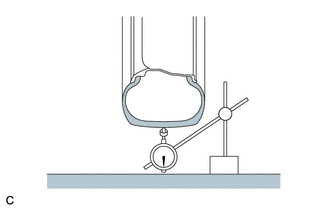
Using a dial indicator, check the runout of the tires.
Tire runout
1.4 mm (0.0551 in.) or less
ROTATE TIRES
-
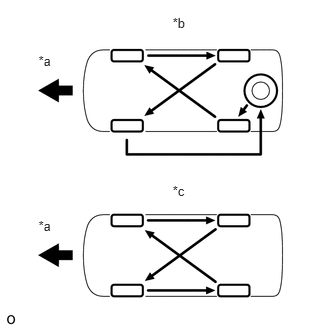
*a
Front of the Vehicle
*b
Vehicle Wheels and Spare Tire Wheel are Same Type
*c
Vehicle Wheels and Spare Tire Wheel are Not Same Type, or There is No Spare Tire
Rotate the tires as shown in the illustration.
103 N*m
1050 kgf*cm
76 ft.*lbf
-
INSPECT WHEEL BALANCE
-
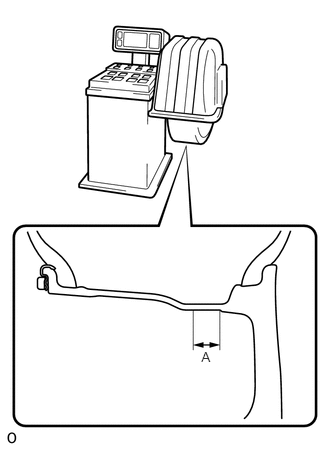
for Aluminum Wheel Type:
Check and adjust the off-the-car balance.
Maximum imbalance after adjustment
8.0 g (0.0176 lb)
Note:Use a cleaning detergent to remove dirt, oil and water from the surface where the balance weight is to be adhered.
Do not touch the sticking surface of the tape.
Adhere a sticking type balance weight to the flat surface (A) shown in the illustration.
Width (A)
25 mm (0.984 in.)
Push the balance weight firmly to adhere it to the position.
Do not reuse the balance weight.
Tip:The inner side balance weights should be installed by clipping them to the rim.
If necessary, check and adjust the on-the-car balance.
-
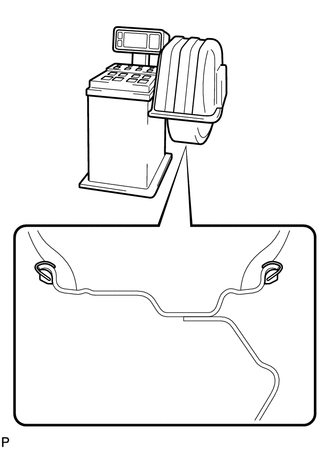
for Steel Wheel Type:
Check and adjust the off-the-car balance.
Maximum imbalance after adjustment
8.0 g (0.0176 lb)
Tip:If necessary, check and adjust the on-the-car balance.
-
INSPECT FRONT AXLE HUB BEARING LOOSENESS
INSPECT FRONT AXLE HUB RUNOUT
INSPECT REAR AXLE HUB BEARING LOOSENESS
INSPECT REAR AXLE HUB RUNOUT