ECD SYSTEM(for Swirl Control Valve), Diagnostic DTC:P0112,P0113 and P1017
| DTC Code | DTC Name |
|---|---|
| P0112 | Intake Air Temperature Sensor 1 Circuit Low Bank 1 |
| P0113 | Intake Air Temperature Sensor 1 Circuit High Bank 1 |
| P1017 | Physical Range High Error for Air Temperature Sensor |
DESCRIPTION
The intake air temperature sensor is built into the Mass Air Flow (MAF) meter and senses the intake air temperature.
A thermistor built into the sensor changes its resistance value according to the intake air temperature.
The lower the intake air temperature, the greater the thermistor resistance value. The higher the intake air temperature, the lower the thermistor resistance value.
The intake air temperature sensor is connected to the ECM. The 5 V power source voltage in the ECM is applied to the intake air temperature sensor from terminal THA via resistor R. Resistor R and the intake air temperature sensor are connected in series. When the resistance value of the intake air temperature sensor changes in accordance with changes in the intake air temperature, the potential at terminal THA also changes. Based on this signal, the ECM increases the fuel injection volume to improve drivability with a cold engine.
When the intake air temperature sensor output is outside the normal range, the ECM determines that this is a malfunction.
DTC No. |
DTC Detection Condition |
Trouble Area |
|---|---|---|
P0112 |
Intake air temperature sensor output is less than 0.125 V for 0.05 seconds. (3 trip detection logic) |
|
DTC No. |
DTC Detection Condition |
Trouble Area |
|---|---|---|
P0113 |
Intake air temperature sensor output is more than 4.85 V for 0.05 seconds. (3 trip detection logic) |
|
DTC No. |
DTC Detection Condition |
Trouble Area |
|---|---|---|
P1017 |
Intake air temperature sensor output is more than 144.9°C (292.8°F) for 1 second. (3 trip detection logic) |
|
DTC No. |
Data List |
|---|---|
P0112 P0113 P1017 |
Intake Air |
WIRING DIAGRAM
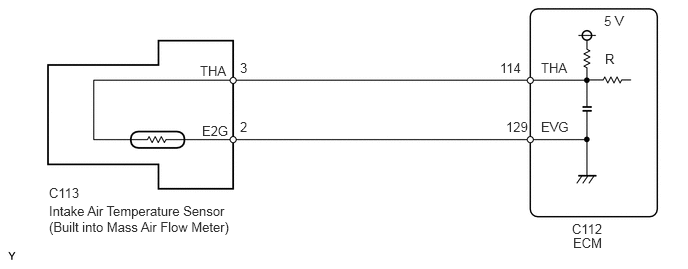
CAUTION / NOTICE / HINT
When replacing the ECM, the ECM needs Registration and Initialization (Click here).
After replacing the mass air flow meter, the ECM needs initialization (Click here).
When the ECM must be replaced, before replacing the ECM, perform the "Learning Values Save" function using the GTS. Then after installing the new ECM, perform all of the initialization/registrations for the "Learning Values Write" function by following the instructions shown on the GTS display.
Read freeze frame data using the GTS. Freeze frame data records the engine condition when malfunctions are detected. When troubleshooting, freeze frame data can help determine if the vehicle was moving or stationary, if the engine was warmed up or not, and other data from the time the malfunction occurred.
PROCEDURE
READ VALUE USING GTS (INTAKE AIR)
Connect the GTS to the DLC3.
Turn the ignition switch to ON and turn the GTS on.
Enter the following menus: Powertrain / Engine and ECT / Data List / Intake Air.
Read the value.
OK
Same as actual intake air temperature.
Table 2. Result Result
Proceed to
-40°C (-40°F)
A
140°C (284°F) or higher
B
Same as actual intake air temperature
C
Tip:If there is an open circuit, the GTS indicates -40°C (-40°F).
If there is a short circuit, the GTS indicates 140°C (284°F) or higher.
READ VALUE USING GTS (CHECK FOR SHORT IN WIRE HARNESS)Click here
CONFIRM WHETHER MALFUNCTION HAS BEEN SUCCESSFULLY REPAIREDClick here
READ VALUE USING GTS (CHECK FOR OPEN IN WIRE HARNESS)
Disconnect the mass air flow meter connector.
Connect terminals C113-3 (THA) and C113-2 (E2G) of the mass air flow meter wire harness side connector.
Connect the GTS to the DLC3.
Turn the ignition switch to ON and turn the GTS on.
Enter the following menus: Powertrain / Engine and ECT / Data List / Intake Air.
Read the value.
Standard value
140°C (284°F) or higher
CONFIRM GOOD CONNECTION TO SENSOR. IF OK, REPLACE MASS AIR FLOW METERClick here
CHECK HARNESS AND CONNECTOR (MASS AIR FLOW METER - ECM)
Disconnect the mass air flow meter connector.
Disconnect the ECM connector.
Measure the resistance according to the value(s) in the table below.
Standard Resistance
Tester Connection
Condition
Specified Condition
C113-3 (THA) - C112-114 (THA)
Always
Below 1 Ω
C113-2 (E2G) - C112-129 (EVG)
Always
Below 1 Ω
CONFIRM GOOD CONNECTION TO ECM. IF OK, REPLACE ECMClick here
REPAIR OR REPLACE HARNESS OR CONNECTORClick here
READ VALUE USING GTS (CHECK FOR SHORT IN WIRE HARNESS)
Disconnect the mass air flow meter connector.
Connect the GTS to the DLC3.
Turn the ignition switch to ON and turn the GTS on.
Enter the following menus: Powertrain / Engine and ECT / Data List / Intake Air.
Read the value.
Standard value
-40°C (-40°F)
REPLACE MASS AIR FLOW METERClick here
CHECK HARNESS AND CONNECTOR (MASS AIR FLOW METER - ECM)
Disconnect the mass air flow meter connector.
Disconnect the ECM connector.
Measure the resistance according to the value(s) in the table below.
Standard Resistance
Tester Connection
Condition
Specified Condition
C113-3 (THA) or C112-114 (THA) - Body ground
Always
10 kΩ or higher
REPAIR OR REPLACE HARNESS OR CONNECTORClick here
REPLACE ECM
Replace the ECM (Click here).
CONFIRM WHETHER MALFUNCTION HAS BEEN SUCCESSFULLY REPAIREDClick here
CONFIRM GOOD CONNECTION TO SENSOR. IF OK, REPLACE MASS AIR FLOW METER
Replace the mass air flow meter (Click here).
Perform the air flow meter learning value reset (Click here).
CONFIRM WHETHER MALFUNCTION HAS BEEN SUCCESSFULLY REPAIREDClick here
REPAIR OR REPLACE HARNESS OR CONNECTOR
Repair or replace the harness or connector.
CONFIRM WHETHER MALFUNCTION HAS BEEN SUCCESSFULLY REPAIREDClick here
CONFIRM GOOD CONNECTION TO ECM. IF OK, REPLACE ECM
Replace the ECM (Click here).
CONFIRM WHETHER MALFUNCTION HAS BEEN SUCCESSFULLY REPAIREDClick here
REPLACE MASS AIR FLOW METER
Replace the mass air flow meter (Click here).
Perform the air flow meter learning value reset (Click here).
CONFIRM WHETHER MALFUNCTION HAS BEEN SUCCESSFULLY REPAIRED
Connect the GTS to the DLC3.
Turn the ignition switch to ON and turn the GTS on.
Clear the DTCs (Click here).
Turn the ignition switch off and wait for 60 seconds or more [A].
Perform road test [B].
Repeat [A] and [B] for the number of trips detected.
Enter the following menus: Powertrain / Engine and ECT / Trouble Codes.
Confirm that the DTC is not output again.
END