SFI SYSTEM(w/o EGR System) VC Output Circuit
| DTC Code | DTC Name |
|---|---|
| VC Output Circuit |
DESCRIPTION
The ECM constantly generates 5 V power source voltage from the auxiliary battery voltages supplied to the +B (BATT) terminal to operate the microprocessor. The ECM also provides this power source voltage to the sensors through the VC output circuit.
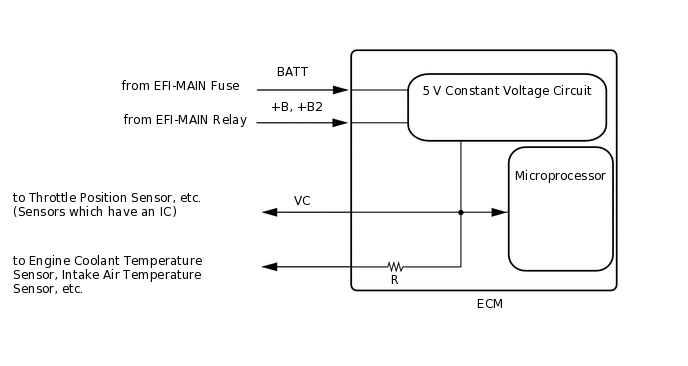
When the VC circuit has a short circuit, the microprocessor in the ECM and sensors that are supplied power through the VC circuit are deactivated because power is not supplied from the VC circuit. When the system is in this condition, it will not start.
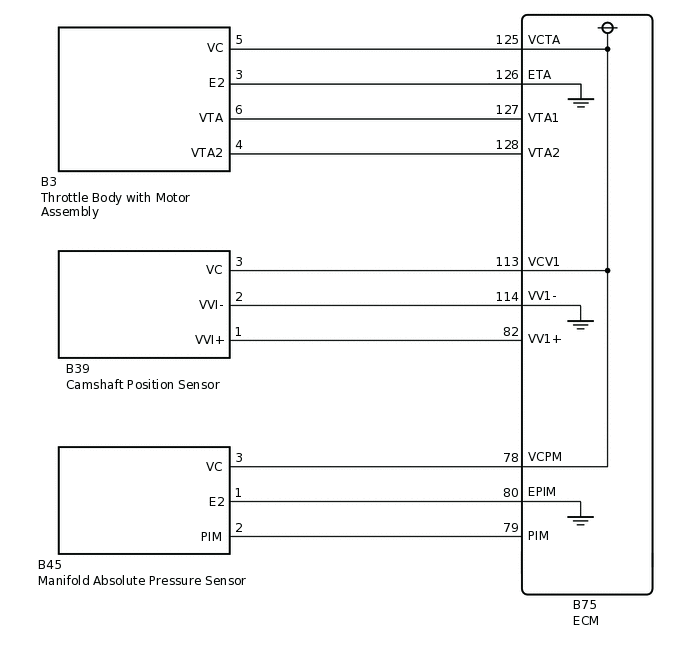
WIRING DIAGRAM
For the circuit diagram of the ECM power source, refer to the ECM power source circuit.
VC Output Circuit
PROCEDURE
CHECK COMMUNICATION BETWEEN GTS AND ECM
Connect the GTS to the DLC3.
Turn the power switch on (IG).
Turn the GTS on.
Check the communication between the GTS and ECM.
Tip:It can be checked using the "Engine and ECT" item of the Data List.
Result
Result
Proceed to
Communication is not possible
A
Communication is possible
B
CHECK EFI NO. 1 FUSE VOLTAGE
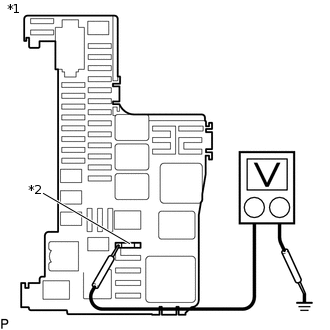
*1
Engine Room Relay Block and Junction Block Assembly
*2
EFI NO. 1 Fuse
Turn the power switch on (IG).
Measure the voltage according to the value(s) in the table below.
Standard Voltage
Tester Connection
Condition
Specified Condition
1 (EFI NO. 1 fuse) - Body ground
Power switch on (IG)
11 to 14 V
Tip:Check the fuse with it installed to the engine room relay block and junction block assembly.
If the result is not as specified, since current is not flowing to the +B and +B2 terminals of the ECM, the system may not be started.
Result
Proceed to
OK
NG
CHECK COMMUNICATION BETWEEN GTS AND ECM (THROTTLE POSITION SENSOR)
Disconnect the throttle body with motor assembly connector.
Turn the power switch on (IG).
Turn the GTS on.
Check the communication between the GTS and ECM.
Tip:It can be checked using the "Engine and ECT" item of the Data List.
Result
Result
Proceed to
Communication is not possible
A
Communication is possible
B
Tip:Perform "Inspection After Repair" after replacing the throttle body with motor assembly.
CHECK COMMUNICATION BETWEEN GTS AND ECM (CAMSHAFT POSITION SENSOR)
Disconnect the camshaft position sensor connector.
Turn the power switch on (IG).
Turn the GTS on.
Check the communication between the GTS and ECM.
Tip:It can be checked using the "Engine and ECT" item of the Data List.
Result
Result
Proceed to
Communication is not possible
A
Communication is possible
B
CHECK COMMUNICATION BETWEEN GTS AND ECM (MANIFOLD ABSOLUTE PRESSURE SENSOR)
Disconnect the manifold absolute pressure sensor connector.
Turn the power switch on (IG).
Turn the GTS on.
Check the communication between the GTS and ECM.
Tip:It can be checked using the "Engine and ECT" item of the Data List.
Result
Result
Proceed to
Communication is not possible
A
Communication is possible
B
CHECK HARNESS AND CONNECTOR
Disconnect the throttle body with motor assembly connector.
Disconnect the camshaft position sensor connector.
Disconnect the manifold absolute pressure sensor connector.
Disconnect the ECM connectors.
Measure the resistance according to the value(s) in the table below.
Standard Resistance
Tester Connection
Condition
Specified Condition
B3-5 (VC) or B75-125 (VCTA) - Body ground and other terminals
Always
10 kΩ or higher
B39-3 (VC) or B75-113 (VCV1) - Body ground and other terminals
Always
10 kΩ or higher
B45-3 (VC) or B75-78 (VCPM) - Body ground and other terminals
Always
10 kΩ or higher
V3-6 (VCC) or A62-34 (VCPP) - Body ground and other terminals
Always
10 kΩ or higher
1 (EFI NO. 1 fuse) - A62-2 (+B)
Always
Below 1 Ω
1 (EFI NO. 1 fuse) - A62-3 (+B2)
Always
Below 1 Ω
1 (EFI NO. 1 fuse) or A62-2 (+B) - Body ground and other terminals
Always
10 kΩ or higher
1 (EFI NO. 1 fuse) or A62-3 (+B2) - Body ground and other terminals
Always
10 kΩ or higher
Result
Proceed to
OK
NG
NG REPAIR OR REPLACE HARNESS OR CONNECTOR