CONTINUOUSLY VARIABLE TRANSAXLE SYSTEM HYDRAULIC TEST
-
PERFORM HYDRAULIC TEST
CAUTION:
-
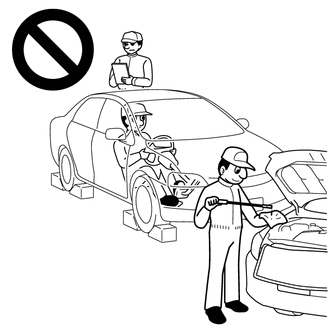
-
Do not perform a stall test if there are any people or objects near the vehicle.
-
The vehicle could begin moving suddenly, resulting in a serious accident.
-
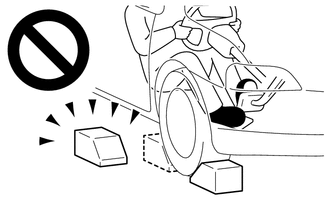
-
Do not perform a stall test if any wheel chocks are out of position.
-
The vehicle could begin moving suddenly, resulting in a serious accident.
-
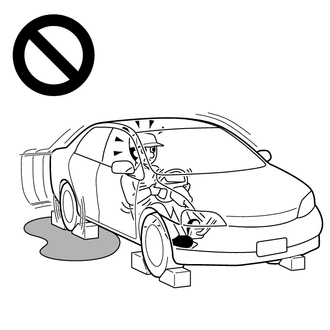
-
Do not perform the stall test on a slippery or low-friction surface that could allow the tires to spin.
-
The vehicle could begin moving suddenly, resulting in a serious accident.
Note
-
This test must be performed after checking and confirming that the engine is normal.
-
Perform this test with the CVT fluid temperature between 50 and 100°C (122 and 212°F).
-
Perform this test with the air conditioning off.
-
Do not perform the stall speed test for more than 5 seconds.
-
When performing the stall speed test more than once, make sure to wait 15 seconds or more between tests.
-
Measure the secondary oil pressure.
-
Fully apply the parking brake and chock all 4 wheels.
-
Connect the GTS to the DLC3.
-
Start the engine.
-
Turn the GTS on.
-
Enter the following menus: Powertrain / Engine and ECT / Active Test / Connect the TC and TE1 / Data List / A/T Oil Pressure.
Tech Tips
Observe the value of A/T Oil Pressure in the Data List on the screen while performing the Active Test.
Powertrain > Engine and ECT > Active TestTester Display Connect the TC and TE1 -
Keep your left foot firmly on the brake pedal and move the shift lever to D.
-
Depress the accelerator pedal as much as possible with your right foot. Quickly read the highest secondary oil pressure reading when the engine speed reaches stall speed and release the accelerator pedal immediately.
-
Keep your left foot firmly on the brake pedal and move the shift lever to R.
-
Depress the accelerator pedal as much as possible with your right foot. Quickly read the highest secondary oil pressure reading when the engine speed reaches stall speed and release the accelerator pedal immediately.
Specified Secondary Oil Pressure Stall Speed Shift Lever Position Secondary Oil Pressure 2200 +/- 300 rpm D 3.9 to 4.7 MPa
(39.8 to 47.9 kgf/cm2, 566 to 682 psi)
R 3.7 to 4.9 MPa
(37.7 to 50.0 kgf/cm2, 537 to 711 psi)
Tech Tips
If the secondary oil pressure exceeds the maximum value or drops below the minimum value, a solenoid valve, regulator valve or modulator valve may be malfunctioning.
-
-